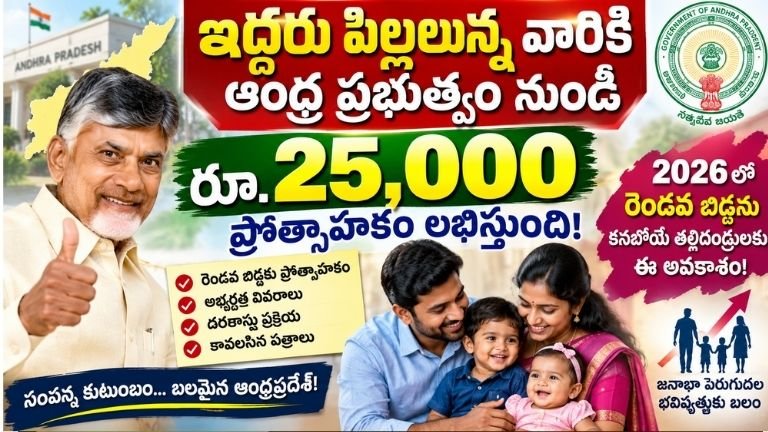
Andhra Pradesh ₹25,000 Second Child Incentive 2026: Who Can Get the Benefit, Why the Government Is Encouraging Larger Families b3
Andhra Pradesh has introduced a major discussion around its new Population Management Policy 2026, focusing on the state’s declining fertility rate, ageing population and the possibility of a shortage of young people in the future.
One of the most talked-about proposals under the policy is a ₹25,000 financial incentive for the birth of a second child. The proposal was initially announced by Andhra Pradesh Chief Minister N. Chandrababu Naidu in March 2026, with the objective of encouraging eligible families to consider having a second child. (India Today)
The announcement has attracted significant attention because India has traditionally focused on population control and smaller families. Andhra Pradesh is now discussing a different approach: supporting families and encouraging a sustainable population structure.
However, there is an important point that parents should understand. The ₹25,000 amount was announced as part of the state’s population policy, while subsequent announcements in May 2026 introduced additional incentives for third and fourth children. Therefore, families should check the latest government guidelines before assuming that they can immediately claim the benefit or before relying on a particular application procedure. (Hindustan Times)
What Is the Andhra Pradesh ₹25,000 Second Child Scheme?
The proposed/announced financial incentive is part of Andhra Pradesh’s broader Population Management Policy.
In March 2026, the Chief Minister told the Andhra Pradesh Legislative Assembly that the government was considering giving ₹25,000 to parents when they have a second child or more. The stated objective was to address the decline in the birth rate and move the state’s Total Fertility Rate towards the replacement level of 2.1. (India Today)
The government’s approach is based on the concern that a falling fertility rate today can result in a smaller working-age population in the future.
According to the policy discussion note released in March, the direct birth incentive was proposed as a payment of ₹25,000 to mothers upon the birth of a second child onwards. (Cfw AP)
This means that the announcement is not simply a conventional welfare scheme. It is part of a larger demographic strategy involving maternal health, childcare, education, elderly welfare, employment and population management.
Why Is Andhra Pradesh Encouraging a Second Child?
The main reason is the changing demographic situation.
For several decades, India and many states successfully reduced fertility rates through better education, healthcare, awareness and family-planning programmes. As a result, families have become smaller.
While this has many benefits, very low fertility over a long period can create another challenge: the number of young people entering the workforce can eventually decline.
Andhra Pradesh has highlighted this concern while discussing its new population policy. The state’s fertility rate has been reported at around 1.5, which is below the commonly cited replacement level of 2.1. (India Today)
The government is therefore attempting to encourage families to have two or more children while simultaneously creating better support systems for parents.
The policy is particularly focused on the long-term future rather than only the immediate population numbers.
What Does Fertility Rate Mean?
The term Total Fertility Rate (TFR) is important when understanding this policy.
TFR broadly refers to the average number of children a woman is expected to have over her lifetime based on prevailing age-specific fertility rates.
A replacement-level fertility rate is generally around 2.1 children per woman in many demographic contexts. A rate below replacement level, if sustained for a long period, can eventually contribute to population ageing and a reduction in the working-age population.
Andhra Pradesh’s government has said that it wants to move the state’s fertility rate towards 2.1. (India Today)
The ₹25,000 incentive is therefore being presented as one component of a broader strategy.
Who Is the ₹25,000 Incentive Intended For?
Based on the March 2026 policy announcement, the incentive is intended for families having a second child or subsequent children.
The government’s discussion note specifically described a direct birth incentive of ₹25,000 at the birth of a second child onwards. (Cfw AP)
For families planning a second child in 2026, this has naturally raised several questions:
- Who will qualify?
- Is there an income limit?
- Does the mother need to be an Andhra Pradesh resident?
- Is Aadhaar required?
- Will the amount be transferred directly to a bank account?
- What documents will be required?
- Will the benefit apply to every second child?
- What will be the official application process?
- Will births in private hospitals also qualify?
- What is the exact implementation date?
These details are extremely important.
At the time of the original announcement, the government was still developing the policy and further implementation details were expected. Therefore, parents should not rely on unofficial social-media posts claiming that a particular website or application form is already available unless it is confirmed through an official government notification.
Is This Only for Families Having Two Children?
The original March announcement discussed ₹25,000 for a second child and onwards.
The policy later received additional attention when the Chief Minister announced enhanced incentives for families having a third and fourth child.
In May 2026, Andhra Pradesh announced ₹30,000 for the birth of a third child and ₹40,000 for a fourth child as part of efforts to address declining population growth. (Hindustan Times)
This is important because many social-media posts may combine the March and May announcements and present them as one single scheme.
The broader policy should therefore be understood as a package rather than only a ₹25,000 payment.
Benefits Proposed Under the Population Management Policy
The Andhra Pradesh government’s population strategy goes beyond direct cash assistance.
The March policy discussion note included several areas of support.
1. Direct Birth Incentive
A direct financial incentive of ₹25,000 was proposed for the birth of a second child onwards. (Cfw AP)
This is the component that has received the most public attention.
2. Nutrition Support
The policy proposed additional nutritional support for third-born children.
The discussion around the policy included a monthly support amount for the third child for the first five years, subject to conditions such as immunisation and growth monitoring. (Cfw AP)
The purpose is not only to encourage childbirth but also to make sure that children receive adequate nutrition during their early years.
3. Education Support
The policy also proposed education support for children in larger families.
The March policy documents discussed providing education support for third and subsequent children, including government-supported education up to the age of 18 under specified arrangements. (Cfw AP)
This could become an important part of the policy because education expenses are one of the major concerns for parents considering a larger family.
4. Health Support
The proposed policy also places emphasis on healthcare.
It includes broader maternal and child health measures and health protection for households with three or more children. (Cfw AP)
The intention is to make population growth compatible with family welfare.
Why Is the Government Talking About the Future of Young People?
One of the major concerns behind the policy is the future size of the working-age population.
A healthy economy needs people of working age to support businesses, government services, healthcare, education and other sectors.
If fewer children are born for several decades, the number of young workers can eventually decline while the number of elderly people increases.
This creates a demographic imbalance.
Andhra Pradesh has therefore argued that today’s population decisions can affect the state several decades later.
The government has also linked the issue to the wider demographic situation in southern India, where fertility rates have fallen significantly compared with previous generations. (The Indian Express)
What Does This Have to Do With South India’s Population?
The population debate is not limited to Andhra Pradesh.
Several southern states have experienced significant declines in fertility because of improvements in education, healthcare, urbanisation, women’s employment and family planning.
This has been a major development success story. However, policymakers are increasingly discussing the possibility that very low fertility rates could eventually lead to an ageing population.
There is also a political dimension.
India’s parliamentary representation is linked to population, and southern states have historically been concerned that population-based changes in future delimitation could affect their representation because these states achieved lower population growth earlier.
The Andhra Pradesh government’s population policy has therefore been discussed in the context of both economic and demographic concerns. (The Indian Express)
What About Parents Having a Baby in 2026?
Parents expecting a second child in 2026 are among those most interested in the announcement.
The policy discussion specifically included a ₹25,000 birth incentive for the second child onwards. (Cfw AP)
However, parents should distinguish between a policy announcement, a government policy framework and a fully operational application scheme.
Before applying for any benefit, parents should confirm:
- Whether the scheme is currently operational.
- The exact eligibility conditions.
- The applicable date of birth.
- Whether the benefit is automatic or requires an application.
- Which department is responsible.
- Whether the payment is made through DBT.
- Which documents are required.
- Whether registration at an authorised health facility is compulsory.
This is particularly important because scheme details can change during implementation.
What Documents May Be Required?
The final list should be confirmed through an official government notification.
Generally, birth-related government benefits may require documents such as:
- Parent’s Aadhaar details
- Child’s birth certificate
- Bank account details
- Mobile number
- Residence or domicile proof, where applicable
- Hospital or delivery records
- Mother and child health records
- Relevant registration documents
However, these should not be treated as the final official document list for the ₹25,000 incentive until the government publishes the implementation guidelines.
Parents should avoid submitting personal documents to unofficial websites or individuals claiming to process the scheme.
Is There an Online Application?
One of the biggest questions among parents is whether they can apply online.
At the time of the initial announcement, the government was still working on the policy framework and implementation details. News reports from March described the ₹25,000 payment as a proposed or planned incentive. (India Today)
Therefore, people should be careful with social-media posts saying:
“Apply immediately and get ₹25,000.”
Unless an official application portal and procedure have been announced, such claims should be verified.
The safest approach is to check official Andhra Pradesh government departments, health department announcements, MeeSeva-related information where applicable, or notices from authorised government offices.
Is the ₹25,000 Payment Given Before or After Delivery?
The original policy proposal described the incentive as being provided at the time of delivery/birth.
The March policy discussion note described it as a direct financial incentive to mothers upon the birth of a second child onwards. (Cfw AP)
This suggests that the benefit is connected to the actual birth rather than simply registering a pregnancy.
Nevertheless, parents should wait for the final implementation rules to understand the exact process, timing and verification requirements.
What About the Third Child?
The third-child component has changed in the government’s later announcements.
The initial March policy discussions included ₹25,000 for the second child onwards, along with additional support for the third child.
Later, in May 2026, Chief Minister Chandrababu Naidu announced ₹30,000 for a third child and ₹40,000 for a fourth child. (India Today)
The government also discussed additional support such as nutrition and education.
Therefore, families with a third or fourth child should not assume that the original ₹25,000 announcement is the only benefit available.
Why Is the Government Calling This Population Management?
The government is attempting to move away from the traditional idea of simply reducing population growth.
Instead, the proposed approach focuses on population management and population care.
The policy contains multiple pillars, including maternal wellbeing, women’s workforce participation, elderly welfare, workforce skills and digital healthcare. (The Indian Express)
This means that the government’s objective is not simply:
“Have more children.”
The broader idea is:
“Support families, improve healthcare and childcare, and maintain a sustainable population structure.”
That distinction is important.
Possible Advantages of the Policy
If implemented effectively, supporters argue that the policy could have several long-term benefits.
Supporting Families
A direct payment could help families meet some of the immediate expenses associated with childbirth.
Addressing Low Fertility
Financial assistance combined with healthcare, education and childcare support may encourage some families who want a second child but are worried about expenses.
Supporting the Future Workforce
A stable number of young people could help maintain the state’s workforce in the coming decades.
Preparing for Population Ageing
If fertility remains very low for a long period, the proportion of elderly people can increase. A balanced age structure can help reduce future pressure on working-age populations.
Improving Childcare Support
The broader policy’s focus on childcare, education and maternal health could potentially make it easier for parents to raise children.
Important Concerns and Questions
At the same time, the policy has generated debate.
A cash incentive alone may not be enough to influence family decisions.
Parents consider many factors before having another child, including:
- Household income
- Housing costs
- Education expenses
- Healthcare costs
- Employment opportunities
- Childcare availability
- Women’s career plans
- Urban living expenses
- Support from grandparents and relatives
For many families, these factors may be more important than a one-time payment.
That is why the government’s broader healthcare, childcare, education and employment measures could be as important as the cash incentive itself.
Final Words
The ₹25,000 second-child incentive is one of the most discussed elements of Andhra Pradesh’s 2026 Population Management Policy.
The proposal was introduced in response to concerns about declining fertility, population ageing and the long-term availability of a working-age population. The government’s March policy framework described a ₹25,000 direct birth incentive for a second child onwards. (Cfw AP)
The policy subsequently expanded into a broader discussion of incentives for larger families, including later announcements of ₹30,000 for a third child and ₹40,000 for a fourth child. (Hindustan Times)
For parents expecting a second baby in 2026, the key message is to verify the latest official implementation guidelines before applying or sharing claims online. Eligibility, documentation, payment procedure and application details should be based on an official government notification rather than unofficial social-media information.
The larger goal of the policy is not simply to increase the number of births. Andhra Pradesh is attempting to address a demographic challenge that could become more visible over the coming decades: maintaining a healthy balance between children, working-age adults and senior citizens.
If the policy is implemented together with strong maternal healthcare, childcare, education, employment opportunities and social security, it could become an important experiment in how a state responds to declining fertility and population ageing.
Note: The ₹25,000 figure comes from the 2026 Andhra Pradesh Population Management Policy announcement/discussion. Policy details and incentives have evolved during 2026, so readers should check the latest official notification for the final eligibility and application procedure. (Cfw AP)