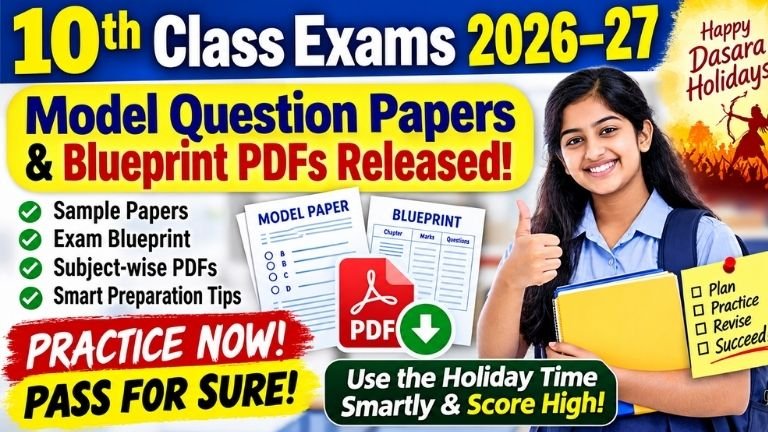
10th Class Exams 2026–27: Model Question Papers and Blueprint PDFs to Help Students Prepare for Exams
Students preparing for their 10th Class board examinations should start their preparation early to achieve good marks. Model question papers, exam blueprints, sample papers, and textbooks can help students understand the examination pattern and prepare more effectively.
Board examinations are an important milestone in every student’s academic journey. With proper planning, regular revision, and consistent practice, students can improve their confidence and perform better in their examinations.
Students are advised to check the latest official notifications from their respective education boards for information about model question papers, blueprint PDFs, examination patterns, and syllabus updates.
10th Class Exams 2026–27: Important Information for Students
Students appearing for the 10th Class examinations should focus on completing their syllabus, revising important topics, and practising questions regularly.
Model question papers are useful study materials that help students understand the types of questions they may encounter. Blueprint documents, where officially provided, can help students understand the structure of question papers and the distribution of marks.
Before downloading any study material, students should verify whether it belongs to the correct state board, academic year, and examination syllabus.
Important: The availability of model question papers and blueprints, as well as any changes to the examination pattern, should be confirmed through the relevant education board’s official website. Students should not assume that the examination pattern remains unchanged without an official announcement.
What Are 10th Class Model Question Papers?
Model question papers are sample examination papers designed to help students practise answering questions based on their syllabus. They provide an opportunity to test their knowledge before appearing for the actual examination.
By solving model question papers, students can understand how questions are presented, how much time they need for different sections, and which topics require additional preparation.
Benefits of Practising Model Question Papers
1. Understand the examination pattern
Model papers help students become familiar with different types of questions, including multiple-choice questions, short-answer questions, long-answer questions, and numerical problems, depending on the subject and examination format.
2. Improve time management
Time management is an important skill during board examinations. Students should practise completing model papers within the official examination duration.
For example, if the examination provides three hours, students can practise answering a suitable model paper within the same time limit. The actual duration should be checked in the official examination instructions.
3. Identify weak areas
After completing a model paper, students should review their answers and identify the topics they could not answer correctly.
They can then revise those topics from their textbooks and practise similar questions until they understand the concepts.
4. Build confidence
Regular practice can make students more comfortable with answering questions under examination conditions. It can also help reduce anxiety by making the examination process more familiar.
However, students should remember that model papers are intended for practice. The exact same questions are not guaranteed to appear in the final examination.
What Is a 10th Class Exam Blueprint?
An examination blueprint is a document that may provide information about the structure of a question paper, the distribution of marks, the types of questions, and other examination-related details.
The information provided in a blueprint can vary between education boards and academic years. Students should therefore refer to the official blueprint applicable to their particular examination.
Important Details Students Should Check in a Blueprint
- Subject-wise question paper structure.
- Types of questions included in different sections.
- Marks allocated to questions or sections.
- Chapter-wise weightage, if officially provided.
- Instructions for answering questions.
- Other examination guidelines mentioned by the board.
A blueprint can help students organise their study schedule and identify areas that need attention. However, students should not completely ignore chapters that appear to have lower weightage.
Preparing the entire prescribed syllabus is a better approach than studying only a few selected topics.
How to Download 10th Class Model Question Papers and Blueprint PDFs
Students can look for model question papers and examination blueprints on their respective state education board websites.
Follow these steps to find the relevant study materials:
- Visit the official website of your state education board.
- Look for sections such as SSC, Class 10, Model Question Papers, Sample Papers, or Blueprint.
- Select the relevant academic year and examination.
- Check the subject name, syllabus, and publication details.
- Download the available PDF files.
- Save the documents on your mobile phone or computer for regular practice.
- If possible, print the question papers and solve them under examination conditions.
Students should avoid relying entirely on PDFs shared through social media. Some documents may belong to previous academic years or different education boards.
Note: Students studying under Andhra Pradesh SSC and Telangana SSC should check their respective official board websites because examination materials and instructions may differ.
How to Use Dasara Holidays for 10th Class Exam Preparation
Dasara holidays can provide students with additional time to revise lessons, complete unfinished portions of the syllabus, and practise model question papers.
Instead of waiting until the last few weeks before the examinations, students should use their holidays to develop a consistent study routine.
Suggested Daily Study Timetable
Students can prepare a timetable according to their individual learning needs and available time.
Morning: Practise Mathematics or another subject that requires more concentration.
Afternoon: Study Science or revise a chapter from Social Science.
Evening: Practise English, Telugu, or another language subject, including grammar and writing exercises.
Night: Review the topics studied during the day and prepare a list of subjects to study the following day.
This is only an example. Students can adjust the schedule according to their schoolwork, learning speed, and personal requirements.
Regular breaks and sufficient sleep are also important for maintaining concentration.
Mathematics Preparation Tips for 10th Class Students
Mathematics requires regular practice. Students should understand formulas and learn how to apply them rather than memorising them without understanding.
Here are some useful preparation tips:
- Revise important formulas regularly.
- Solve textbook examples before attempting difficult problems.
- Practise exercises from each chapter.
- Maintain a separate notebook for formulas and common mistakes.
- Solve numerical problems without looking at the answers.
- Practise model question papers within the prescribed time limit.
When a problem seems difficult, students should review the relevant concept and try solving it again. Repeated practice can help improve accuracy and speed.
How to Prepare for Science Subjects
Science preparation involves understanding concepts, remembering important definitions, practising numerical problems, and learning diagrams where required by the syllabus.
Physics
Students should understand important formulas, units, concepts, and numerical problems. They should practise applying formulas to different types of questions.
Chemistry
Students should revise important concepts, chemical equations, reactions, and definitions included in their prescribed syllabus.
Biology
Students should focus on understanding biological processes, important terms, diagrams, and explanations. Practising diagrams and their labels can be useful when these are required by the examination.
Students should refer to their prescribed textbooks and official syllabus to identify the topics they need to prepare.
Social Science Preparation Tips
Social Science may include History, Geography, Civics, and Economics, depending on the prescribed syllabus.
Students should prepare important events, dates, definitions, geographical concepts, causes, consequences, and other relevant topics.
For long-answer questions, students can organise their responses using a short introduction, clear main points, and a suitable conclusion.
They should also practise map-based questions and other activities if these are included in their syllabus.
Writing clear and relevant answers is more useful than memorising long paragraphs without understanding their meaning.
How to Prepare for Language Subjects
Students should give equal attention to language subjects such as English and Telugu.
Their preparation should include reading comprehension, grammar, vocabulary, writing skills, and prescribed textbook lessons.
Students should practise writing answers, letters, essays, and other formats required by their particular syllabus.
They should also check spelling, punctuation, sentence structure, and grammar while reviewing their written answers.
Regular writing practice can help students become more confident and improve their presentation.
-
- ఆంధ్రప్రదేశ్ (AP BSE): bse.ap.gov.in
- తెలంగాణ (TS BSE): bse.telangana.gov.in .
What Should Students Do After Solving a Model Paper?
Simply completing a model question paper is not enough. Students should also analyse their performance.
After solving a paper, they should:
- Check their answers against reliable answer keys or textbook explanations, where available.
- Identify questions answered incorrectly.
- Revise the concepts related to those questions.
- Note the mistakes in a separate notebook.
- Practise similar questions again.
- Attempt another paper after revising the weak areas.
This process helps students understand their progress and decide which topics require additional attention.
Common Mistakes Students Should Avoid
Depending only on model papers: Model papers are useful for practice, but students should also study their complete prescribed syllabus.
Ignoring textbooks: Textbooks provide the foundation for understanding concepts and preparing accurate answers.
Postponing preparation: Waiting until the final days