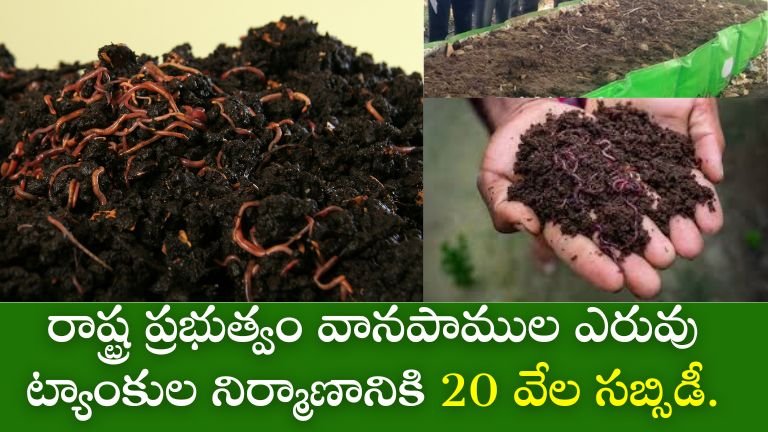
Vermicompost Unit Subsidy: Telangana & Andhra Pradesh (2026 Guide) V 1
Both states provide substantial financial help to reduce the use of chemical fertilizers. While the schemes are similar, the application process differs.
Telangana State: Horticulture & MIDH Scheme
Telangana provides the highest percentage of subsidy for permanent and portable units.
-
Subsidy Amount:
-
Permanent Pits ($30′ \times 8′ \times 2.5’$): 75% subsidy, with a maximum of ₹33,300.
-
Portable HDPE Units (Vermi-beds): Up to 90% subsidy (Farmers often only pay ₹800 – ₹1,200).
-
-
Target Groups: Small and marginal farmers, SC/ST, and Women SHG (Self Help Group) members.
-
Where to Apply:
-
Offline: Visit the Mandal Horticulture Officer (HO) or Mandal Agriculture Officer (MAO).
-
Online: Register on the TGMIP (Telangana Micro Irrigation Project) portal.
-
-
Key Requirements:
-
Udhyan Card: You must be registered as a horticulture farmer.
-
Land Record: Pattadar Passbook is mandatory.
-
Andhra Pradesh: Rythu Bharosa Kendra (RBK) Model
AP has integrated all subsidies into the RBK system, making it the “One-Stop Shop” for farmers.
-
Subsidy Amount:
-
Permanent Units: Usually 50% to 75% subsidy based on the specific district cluster. The standard unit cost is fixed at ₹2,600 per cubic meter.
-
Max Limit: Up to ₹50,000 for larger commercial-grade units.
-
-
Annadatha Sukhibhav (2026): In the 2026 budget, the AP government has allocated specific funds for “Organic Inputs” which includes vermicompost.
-
Where to Apply:
-
Go to your local Rythu Bharosa Kendra (RBK).
-
The Village Agriculture Assistant (VAA) or Village Horticulture Assistant (VHA) will handle your paperwork.
-
-
Key Requirements:
-
e-Crop Booking: Your crop must be registered in the e-panta system for that year.
-
Site Inspection: The VAA must verify the site before construction.
-
Construction & Technical Standards
To get the money released, your pit must follow these specific government designs:
-
Structure: Bricks and cement mortar construction.
-
Flooring: Must be a cemented floor to prevent earthworms from escaping into the soil and to stop pests from entering.
-
Roofing: A permanent or temporary roof (Zinc sheets or palm leaves) is required to keep the pit cool and dark.
-
Input Ratio: Usually 3 parts agricultural waste (dried leaves, stalks) to 1 part cow dung.
Step-by-Step Approval Process (DBT Method)
-
Registration: Submit Aadhaar, Bank Passbook, and Pattadar Passbook at the Mandal/RBK office.
-
Work Order: Receive a formal “Proceeding” or Work Order. Do not start construction before this.
-
Phase 1 Photo: Geo-tagging of the empty land.
-
Phase 2 Photo: Geo-tagging when the walls are built.
-
Phase 3 Photo: Final photo with the roof and earthworms (usually Eisenia fetida species).
-
Payment: The subsidy is released via DBT (Direct Benefit Transfer) in two installments—75% after construction and 25% after one year of maintenance.
Essential Documents Checklist
-
Pattadar Passbook (Original & Xerox)
-
Aadhaar Card (Must be linked to your bank account)
-
MGNREGA Job Card (If applying through the labor scheme)
-
Caste Certificate (For SC/ST to get higher subsidy %)
-
Bank Passbook (Preferably a nationalized bank like SBI or Union Bank)