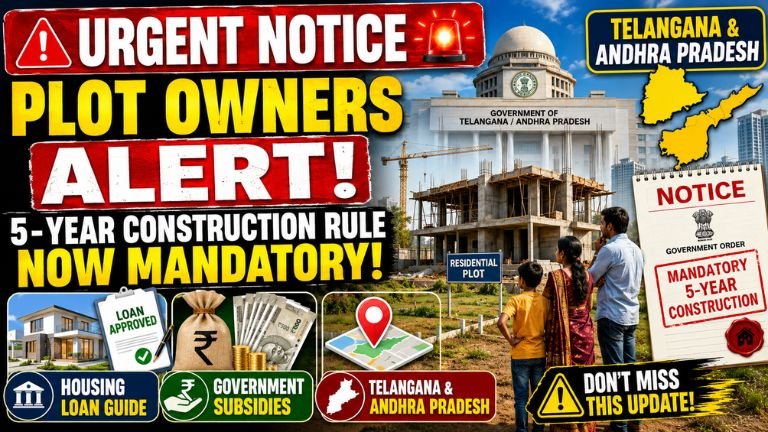
Urgent Notice for Plot Owners in Telangana & Andhra Pradesh: Mandatory 5-Year Construction Rule, Government Subsidies, and Complete Housing Loan Guide h25
Buying a residential plot in prime urban centers or rapidly expanding suburban corridors across Telangana and Andhra Pradesh has long been considered one of the safest real estate investments. However, municipal authorities, urban development bodies, and state housing departments across both Telugu states have clamped down on speculative land holding.
Under updated urban development guidelines and municipal building regulations, plot owners are bound by strict construction timelines. Leaving residential plots vacant indefinitely is no longer a risk-free strategy. This blog post breaks down the regulatory landscape regarding mandatory construction timelines, state and central government housing subsidies, and a step-by-step financial guide to securing a home construction loan.
1. The Mandatory 5-Year Construction Rule: What Plot Owners Must Know
Both Telangana and Andhra Pradesh have revised their building permit laws and layout sanctions to curb urban sprawl, prevent unmaintained vacant plots from turning into public hazards, and accelerate genuine housing development.
Building Sanction Permissibility & Expiration Terms
When you secure a layout plot or obtain a building permit sanction from municipal authorities—such as HMDA (Hyderabad Metropolitan Development Authority), GHMC, TG-bPASS in Telangana, or APCRDA, VMRDA, and local urban bodies under the AP Building Rules in Andhra Pradesh—your permission carries strict expiration deadlines:
- 3-Year to 5-Year Primary Permit Validity: Building permissions granted for non-high-rise individual residential buildings are generally valid for 3 years, while permissions for high-rise or group development schemes remain valid for 5 years.
- Mandatory 6-Month Commencement Rule: Construction activity (such as excavation, foundation work, or basement level construction) must commence within 6 months of receiving sanction. In Telangana, plot owners must upload photographic proof of construction milestones to the TG-bPASS portal.
- Revalidation Window (Maximum 2-Year Extension): If construction is delayed due to valid reasons, property owners can apply for a single revalidation period of up to 2 years upon paying the required fee. Beyond this overall maximum window (typically capping at 5 years total), the building permission lapses completely.
- Re-application Penalty: Once a building permit lapses, you must file a fresh application, submit updated building plans, and pay revised statutory fees based on the latest market value.
Penalties and Risks of Keeping Plots Vacant
| Violation Type | Regulatory Action / Penalty |
| Lapsed Building Approval | Fresh application fees, re-assessment under updated building codes, potential setback adjustments. |
| Unpermitted / Unauthorized Construction | Daily fines ranging from ₹10,000 to ₹50,000 depending on the scale of deviation, followed by stop-work notices or partial demolition. |
| Vacant Land Tax (VLT) | Municipal corporations charge annual VLT (0.5% to 1.5% of market value) on idle plots. Unpaid VLT incurs heavy interest penalties. |
| Encroachment & Title Disputes | Vacant, un-fenced plots face high vulnerability to illegal occupation and forged documentation risks. |
2. Simplifying Construction: Single-Window & Self-Certification Systems
To help landowners comply with the mandatory timelines, both state governments have modernized their approval workflows to eliminate bureaucratic delays.
Telangana: TG-bPASS Framework
Under the TG-bPASS (Telangana Building Permission Approval and Self-Certification System) act:
- Plots Up to 75 Sq. Yds: Exempted from formal building permission. Owners register online with a token fee of ₹1 and self-certify their construction.
- Plots Up to 500 Sq. Mtrs (Height ≤ 10m): Eligible for instant online approval based on self-certification.
- Plots Above 500 Sq. Mtrs or High-Rise: Processed under a single-window system with a strict 21-day clearance deadline.
Andhra Pradesh: AP Building Rules Updates
Under the streamlined AP Building Rules:
- Plots Up to 60 Sq. Yds: Exempted from pre-approval for Ground or Ground+1 structures. Registration via an online portal with a token ₹1 fee is required.
- Buildings Up to 5 Floors (15 Meters): Processed via a Single-Window System. Pre-construction clearances from individual departments (Fire, Revenue, Stamps) are eliminated; submission directly to local municipal bodies suffices.
3. Financial Assistance & Government Housing Subsidies
Building a home on your plot is significantly more affordable if you leverage central and state-sponsored housing schemes.
+-----------------------------------------------------------------------+
|                    FINANCIAL ASSISTANCE ECOSYSTEM                     |
+-----------------------------------------------------------------------+
        |                                                 |
        v                                                 v
  CENTRAL SCHEMES                                   STATE SCHEMES
  - PMAY-Urban 2.0                                 - Telangana: Indiramma
  - Credit Linked Subsidy Scheme (CLSS)              Housing Scheme
  - Interest Subsidy up to ₹2.67 Lakhs             - Andhra Pradesh: PMAY-YSR/
                                                     NTR Housing Assistance
Pradhan Mantri Awas Yojana (PMAY-Urban 2.0)
The central government’s urban housing mission offers interest subsidies on home loans taken for construction on self-owned plots:
- EWS / LIG Categories: Income eligibility capped up to ₹3 Lakhs (EWS) and ₹6 Lakhs (LIG) per annum. Eligible for interest subsidies that can reduce loan interest burdens significantly.
- MIG Category: Available for middle-income groups under specific project cost and square-footage criteria.
- Direct Subsidy Transfer: The interest subsidy is credited upfront to the loan account, reducing the effective principal amount and monthly EMI burden.
Telangana Indiramma Housing Scheme
Telangana provides direct financial assistance to plot owners belonging to Economically Weaker Sections (EWS):
- Financial Grant: Financial support of up to ₹5 Lakhs in phased instalments for plot owners to construct their own houses.
- Beneficiary Selection: Prioritizes landless poor provided with government plots and low-income families owning valid plot titles in rural and urban local bodies.
Andhra Pradesh Housing Assistance
Andhra Pradesh offers financial and material aid for beneficiaries building on private or government-allotted plots:
- Financial Aid: Phased subsidy distribution linked to construction milestones (Basement level, Lintel level, Slab level, and Completion).
- Material Concessions: Subsidized cement, steel, and sand support through state municipal procurement portals.
4. Comprehensive Housing Loan Guide for Plot Owners
If you own a plot and need funds to start construction within the required regulatory window, you can apply for a Plot-Plus-Construction Loan or an Individual House Construction Loan.
Loan-to-Value (LTV) Ratios & Eligibility
Banks and Housing Finance Companies (HFCs) fund construction based on the estimated cost prepared by a certified civil engineer or architect:
- Loan Coverage: Banks typically fund 75% to 90% of the estimated construction cost, subject to borrower income eligibility.
- Tenure: Up to 30 years (or until the primary applicant reaches 65-75 years of age).
- Income Qualification: Salaried employees require at least 2-3 years of work history, while self-employed individuals need 3 years of audited financials and Income Tax Returns (ITR).
Mandatory Document Checklist
+-----------------------------------------------------------------------+
|                           DOCUMENT CHECKLIST                          |
+-----------------------------------------------------------------------+
  [1] Legal & Property Title
      - Original Title Deed (Sale Deed/GIFT Deed)
      - Link Deeds for minimum 13 to 30 years
      - Encumbrance Certificate (EC) for past 13–30 years
      - Up-to-date Property Tax Paid Receipts

  [2] Technical & Sanctions
      - Approved Building Sanction Plan from TG-bPASS / AP Municipal Body
      - Detailed Estimate of Construction by a Chartered Engineer
      - Possession Certificate / Layout Approval (HMDA / DTCP)

  [3] Borrower KYC & Income Proofs
      - PAN, Aadhaar, Proof of Residence
      - Salaried: 6 months Bank Statements, 3 months Payslips, Form 16
      - Self-Employed: 3 years ITRs, P&L Statement, Balance Sheets
Stage-Wise Loan Disbursement Process
Unlike a regular home purchase loan where the full amount is released to the seller in one shot, a construction loan is disbursed in tranches based on real-time site progress:
- Tranche 1 (Foundation/Basement Level): 15% – 20% released after initial excavation and plinth beam completion.
- Tranche 2 (Structure/Slab Level): 30% – 40% released upon completion of roof slabs for designated floors.
- Tranche 3 (Brickwork & Plastering): 20% – 25% released after masonry, electrical wiring, and plumbing conduits are laid.
- Tranche 4 (Finishing & Handover): Final 10% – 15% released upon completion of flooring, painting, and submission of the Occupancy Certificate (OC) or completion photos.
Pro Tip: During the construction phase, banks charge Pre-EMI interest only on the disbursed amount, keeping your cash outflow manageable until the building is complete.
Key Takeaways for Plot Owners
- Check Permit Dates: Verify the approval date on your layout plan or building permit. If 3 years have passed without starting work, apply immediately for revalidation or a fresh permit.
- Avoid Penalties: Constructing without an active, approved plan invites daily fines and potential demolition orders.
- Leverage Subsidies: Apply for PMAY 2.0 or state schemes (Indiramma / AP Housing) early to lower borrowing costs.
- Get Technical Documents Ready: Keep your 13-year EC, Link Deeds, and Chartered Engineer estimate ready to streamline housing loan sanctioning.