subsidies Telangana Micro Irrigation Project 2026: Drip and Sprinkler Irrigation Subsidy, Eligibility, Documents and Application Process
Farmers in Telangana who want to install drip irrigation, micro sprinklers or other micro-irrigation systems can benefit from government assistance under the Telangana Micro Irrigation Project (TGMIP). The programme is designed to improve water-use efficiency, reduce wastage and help farmers obtain better productivity from available irrigation resources.
The Telangana Horticulture Department says the Micro Irrigation Project is being implemented across the state and, from 2023-24, the programme has been implemented under the Rashtriya Krishi Vikas Yojana (RKVY) – Per Drop More Crop framework. The programme includes drip irrigation for different crop spacing, mini and micro sprinklers, portable sprinklers, semi-permanent systems and rain guns.
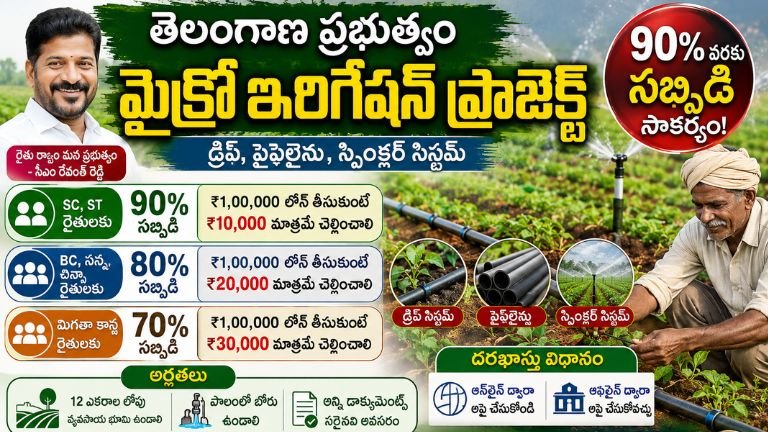
There are many social-media claims about farmers receiving a 90 percent subsidy and paying only 10 percent of the cost. However, the actual subsidy depends on the farmer category, type of irrigation system, eligible area and the applicable government guidelines.
Therefore, farmers should understand the scheme properly before applying.
What Is the Telangana Micro Irrigation Project?
The Telangana Micro Irrigation Project is a government-supported programme intended to encourage farmers to adopt water-saving irrigation technologies.
Traditional irrigation methods can result in considerable water loss through evaporation, runoff and uneven distribution. Micro-irrigation systems deliver water more efficiently to the crop area.
The Telangana Horticulture Department lists several benefits of micro irrigation, including water saving, improved plant growth and yield, reduced labour and energy requirements, improved fertilizer efficiency and better control over irrigation.
The scheme covers different types of irrigation systems, including:
- Drip irrigation for wide-spaced crops
- Inline drip irrigation for close-spaced crops
- Mini sprinklers
- Micro sprinklers
- Portable sprinklers
- Semi-permanent sprinklers
- Rain-gun systems
The exact system available to a farmer depends on the crop, land, irrigation requirements and applicable technical guidelines.
Is This a Loan or a Subsidy?
This is an important point that farmers should understand.
The TGMIP assistance is primarily described as a subsidy for micro-irrigation systems, not as a normal ₹1 lakh loan where the government simply writes off ₹70,000, ₹80,000 or ₹90,000.
Therefore, it is better not to describe the programme as a loan-waiver scheme.
For example, if an eligible micro-irrigation system has an approved unit cost of ₹1 lakh and the applicable subsidy rate is 90 percent, the government assistance would be calculated according to the approved cost and subsidy rules. The farmer’s contribution would be the balance amount, subject to the applicable unit-cost limits and conditions.
The actual amount of subsidy is therefore not necessarily a flat ₹90,000 for every farmer.
Farmers should check the approved unit cost for their crop and irrigation system before calculating their contribution.
What Is the Subsidy Percentage?
The subsidy percentage is one of the most important parts of the programme.
There are different versions of subsidy information on government pages because the rates can depend on the current implementation guidelines, farmer category, irrigation system and district-level information.
A recent Telangana Horticulture Department awareness document published in 2026 explains subsidy norms of 90 percent for SC/ST farmers, 80 percent for small and marginal farmers and BC farmers, and 70 percent for other farmers with top-up subsidy under the micro-irrigation programme.
At the same time, the TGMIP website currently displays a subsidy structure stating that SC/ST farmers can receive 100 percent for drip systems, BC and small/marginal farmers 90 percent, and other farmers 80 percent, while portable sprinklers have a 75 percent subsidy.
Because these official sources show different structures, farmers should confirm the applicable subsidy rate with the current TGMIP/Horticulture Department notification or local horticulture officer before applying.
This is especially important because subsidy rates can be revised through government orders or programme guidelines.
SC and ST Farmers
SC and ST farmers may receive a higher level of subsidy under applicable TGMIP guidelines.
Some official Telangana Horticulture Department material states that SC/ST farmers can receive up to 100 percent subsidy for eligible drip irrigation systems, while a 2026 awareness document refers to a 90 percent subsidy norm under the current programme presentation.
Therefore, applicants belonging to SC or ST communities should check the rate applicable to their application at the time of registration.
A valid caste certificate may be required during the application and verification process.
BC Farmers
BC farmers can also receive substantial government assistance for eligible micro-irrigation systems.
Official TGMIP information has historically provided higher subsidy levels for BC farmers compared with other categories. The current online TGMIP information lists BC farmers at 90 percent for drip systems, while a 2026 departmental awareness document describes an 80 percent norm for BC and small/marginal farmers under the current programme.
Because of this difference, farmers should not rely on a viral video or social-media post alone.
The exact subsidy applicable to a particular application should be confirmed through the department’s current implementation system.
Small and Marginal Farmers
Small and marginal farmers may also qualify for enhanced assistance.
The purpose is to encourage farmers with relatively smaller landholdings to adopt efficient irrigation technology without having to bear the entire installation cost.
The subsidy is calculated according to the eligible area, approved unit cost and applicable category.
Therefore, a farmer should not assume that owning a particular number of acres automatically means receiving a fixed rupee amount.
Other Category Farmers
Farmers outside the higher-subsidy categories may also be eligible for assistance.
The Telangana Micro Irrigation Project is not restricted only to SC, ST or BC farmers. Official TGMIP information states that farmers in revenue villages can be eligible for micro-irrigation systems subject to the applicable land and programme conditions.
The subsidy percentage for other farmers can be lower than the rate applicable to priority categories.
The exact rate should be confirmed before installation.
Landholding Eligibility
Landholding is another important factor.
The current TGMIP website states that eligible farmers can receive assistance for drip or micro-irrigation systems up to 12.50 acres or the landholding shown in the farmer’s title deed, whichever is less.
Some other departmental pages and older guidelines show a 5-hectare limit, which is approximately 12.36 acres, while current TGMIP material uses 12.50 acres.
This means farmers should verify the current limit applicable to their application.
The important point is that the scheme is subject to an area ceiling. A farmer should not assume that the government will provide subsidy for unlimited acreage.
Is a Borewell Required?
Farmers often ask whether they must have a borewell to qualify.
A reliable irrigation source is obviously important for installing and operating a drip or sprinkler system. However, the exact requirement depends on the irrigation arrangement and the technical verification of the field.
Official TGMIP guidelines also discuss cases involving shared water sources and require a water-sharing certificate in applicable situations.
Therefore, instead of stating that every applicant must necessarily have a private borewell, it is safer to say that the farmer must have an approved and adequate irrigation water source as required under the scheme.
Farmers using a shared borewell or other approved water source should check the documentation requirements with the local horticulture department.
What Irrigation Systems Are Covered?
The programme covers several types of micro-irrigation equipment.
Drip Irrigation
Drip irrigation delivers water close to the root zone of plants.
It is particularly useful for many horticultural and widely spaced crops.
The system can help reduce water wastage and improve the efficiency of fertilizer application.
Inline Drip Irrigation
Inline systems are commonly used for crops planted at closer spacing.
The suitability depends on crop spacing and the technical specifications approved under the programme.
Micro Sprinklers
Micro sprinklers distribute water over a defined area and can be suitable for certain horticultural crops.
Mini Sprinklers
Mini sprinklers are another option available under the micro-irrigation programme.
Portable Sprinklers and Rain Guns
The department also lists portable, semi-permanent and rain-gun sprinkler systems.
Portable sprinkler assistance is subject to separate subsidy and area conditions. The current TGMIP website states a 75 percent subsidy for portable sprinklers subject to the applicable unit limit.
How Much Does the System Cost?
The cost is not the same for every farmer.
The unit cost depends on several factors, including:
- Crop
- Crop spacing
- Irrigation system
- Area
- Pipe requirements
- Technical specifications
- Approved unit cost
The TGMIP FAQ states that drip irrigation unit costs vary approximately from ₹16,585 to ₹1,12,237 per hectare, depending on the crop and spacing, while sprinkler costs also vary according to the system.
Therefore, the example of a ₹1 lakh system should be treated only as an illustration, not as the standard price for every farmer.
Documents Required for Application
Farmers should keep the necessary documents ready before applying.
The official TGMIP guidelines mention several documents for beneficiary registration and subsidy processing.
Potentially required documents include:
- Aadhaar card
- Recent passport-size photograph
- Mobile number
- Bank account details
- IFSC code
- Aadhaar-linked bank account
- Title deed or land ownership document
- 1-B Register document, where applicable
- Pattadar Pass Book
- Field Measurement Book or combined field sketch
- Identity proof
- Caste certificate for eligible SC/ST/BC applicants
- Water-sharing certificate, where applicable
The official guidelines specifically mention title deed or 1-B Register/Pattadar Pass Book documents and identity documents. They also mention caste certificates for SC/ST and BC farmers.
The exact documents required can vary depending on the applicant and application type.
Aadhaar and Bank Account
Aadhaar is an important part of the registration process.
The TGMIP website states that farmers can register using Aadhaar-linked authentication through the website or through MeeSeva.
Farmers should therefore make sure that their Aadhaar-linked mobile number and bank information are correct.
Incorrect bank details can create problems during subsidy processing.
How to Apply Online
The Telangana Horticulture Department says TGMIP is implemented through an online web portal.
Farmers can register through the department’s online system using Aadhaar-linked OTP authentication, according to the department’s current TGMIP information.
The general process is:
Step 1: Check Eligibility
First, check your farmer category, landholding, crop and irrigation requirement.
Step 2: Keep Documents Ready
Prepare Aadhaar, land records, bank details, photograph and caste certificate where applicable.
Step 3: Register
Complete the TGMIP registration through the official online system or the authorised channel.
Step 4: Select the Irrigation Requirement
Provide the required information about the crop, land and proposed irrigation system.
Step 5: Field Verification
The application can go through inspection and verification.
The department’s system provides SMS updates at different stages of the application.
Step 6: Choose an Empanelled Supplier
The TGMIP website states that farmers have the freedom to select their preferred micro-irrigation supplier from the empanelled companies.
Step 7: Installation
After approval and completion of the required process, the irrigation system can be installed according to the approved technical specifications.
Can Farmers Apply Through MeeSeva?
Yes.
The official TGMIP information says farmers can register their applications through MeeSeva or through the department’s website using Aadhaar-linked OTP authentication.
Farmers who are not comfortable with online applications can therefore approach an authorised MeeSeva centre for assistance.
They should keep the acknowledgement or application number safely after registration.
Application Status Tracking
Farmers do not necessarily have to visit an office repeatedly to know what is happening with their application.
According to the TGMIP website, applicants receive SMS alerts at different stages, including registration, preliminary inspection, beneficiary contribution, administrative sanction and final payment. Farmers can also track the application online using their unique HP ID.
This makes it easier to identify whether the application is pending, approved or requires further action.
Important: Do Not Install the System Before Approval
Farmers should not independently purchase and install an irrigation system expecting reimbursement later unless the department specifically authorises that process.
The subsidy programme follows prescribed procedures, technical specifications and verification requirements.
Therefore, applicants should first register and follow the instructions provided by the Horticulture Department.
Installing equipment outside the approved process could create problems when claiming subsidy.
Benefits of Micro Irrigation
Micro irrigation can provide several advantages to farmers.
Water Saving
Water is delivered more efficiently to the crop root zone.
Better Crop Management
Controlled irrigation can help farmers manage crop water requirements more effectively.
Reduced Labour
Automated or efficient irrigation can reduce some manual irrigation work.
Fertilizer Efficiency
Fertigation can potentially improve fertilizer-use efficiency when properly managed.
Improved Productivity
Better water management can contribute to healthier crop growth and improved productivity under suitable conditions.
The Telangana Horticulture Department lists water saving, enhanced plant growth and yield, labour and energy savings and improved fertilizer efficiency among the benefits of micro irrigation.
Final Words
The Telangana Micro Irrigation Project can be an important opportunity for farmers who want to install drip irrigation, micro sprinklers or sprinkler systems at a subsidised cost.
However, farmers should understand one important point: this is a subsidy programme, not simply a loan-waiver programme.
The subsidy percentage is determined according to the applicable government rules, farmer category, irrigation system, eligible area and approved unit cost.
Official Telangana sources currently show different subsidy presentations, including a 2026 departmental awareness document describing 90 percent for SC/ST, 80 percent for small and marginal and BC farmers, and 70 percent for others with top-up subsidy, while the TGMIP website currently displays another structure.
Because of this, farmers should verify the current applicable subsidy rate with the Telangana Horticulture Department before making financial calculations.
The programme covers drip irrigation, inline and online drip systems, mini and micro sprinklers, portable sprinklers, semi-permanent systems and rain guns. Farmers can register through the official TGMIP system or authorised MeeSeva channels, subject to the applicable procedure.
Before applying, keep Aadhaar, land records, bank details, photograph and category certificates ready where applicable. Farmers should also make sure that the land and irrigation source meet the programme requirements.
Most importantly, do not pay unofficial agents who promise guaranteed approval or a fixed subsidy amount. Use the official Telangana Horticulture Department channels and follow the current guidelines.
For farmers looking to reduce water wastage and improve irrigation efficiency, the Telangana Micro Irrigation Project can provide valuable financial assistance toward modern irrigation infrastructure, provided the farmer meets the current eligibility and technical requirements.