PMEGP Loan 2026: Get Up to ₹50 Lakh Project Finance with Subsidy – Eligibility, Benefits and How to Apply
Starting a small business often requires significant investment in machinery, equipment, working capital, shop infrastructure and other expenses. For aspiring entrepreneurs who want to establish a new micro-enterprise, the Government of India operates the Prime Minister’s Employment Generation Programme (PMEGP).
PMEGP is a credit-linked subsidy programme designed to encourage self-employment and create employment opportunities through new micro-enterprises in the non-farm sector.
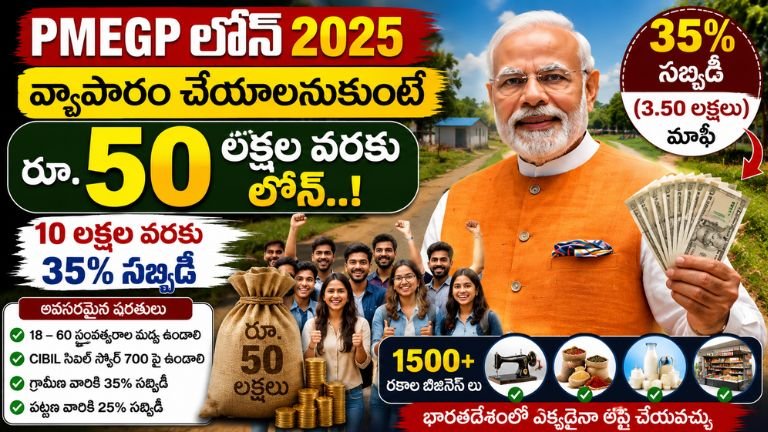
Eligible applicants can obtain bank finance for their proposed business project and may receive margin-money subsidy of up to 35% of the eligible project cost, depending on their category and whether the project is located in a rural or urban area. The current PMEGP guidelines permit subsidy-linked project costs of up to ₹50 lakh for manufacturing projects and ₹20 lakh for business/service projects.
This means that viral claims saying every applicant automatically receives a ₹50 lakh loan or a ₹3.50 lakh subsidy should be understood carefully. The actual loan amount, subsidy and bank finance depend on the project, category, location, applicant contribution, bank appraisal and PMEGP rules.
What Is PMEGP?
PMEGP stands for Prime Minister’s Employment Generation Programme.
It is implemented by the Khadi and Village Industries Commission (KVIC) under the Ministry of Micro, Small and Medium Enterprises (MSME), with implementing agencies including KVIC, KVIBs and District Industries Centres.
The primary objective is to help eligible entrepreneurs establish new viable micro-enterprises and generate sustainable employment.
The programme is especially useful for people who have a business idea but need financial support to purchase machinery, establish a workshop, open a service unit or start another eligible business.
How Much Loan Can You Get Under PMEGP?
One of the most important points to understand is the difference between project cost, bank loan and subsidy.
Under the revised PMEGP guidelines, the maximum project cost eligible for margin-money subsidy is:
- Manufacturing sector: ₹50 lakh
- Business/service sector: ₹20 lakh
If the total project cost is higher than these limits, the additional amount may be financed by the bank without PMEGP subsidy, subject to the bank’s credit decision and applicable rules.
Therefore, it is more accurate to say that PMEGP supports projects costing up to ₹50 lakh in manufacturing and ₹20 lakh in business/service for subsidy purposes, rather than saying that the government simply gives every applicant a ₹50 lakh loan.
How Does the Subsidy Work?
PMEGP provides margin-money subsidy rather than simply depositing the subsidy amount into the applicant’s personal bank account.
The subsidy percentage depends on the applicant’s category and the location of the proposed unit.
General Category
For general-category beneficiaries:
- Rural area: 25% subsidy
- Urban area: 15% subsidy
- Beneficiary contribution: generally 10%
Special Category
For beneficiaries belonging to eligible special categories:
- Rural area: 35% subsidy
- Urban area: 25% subsidy
- Beneficiary contribution: generally 5%
Special categories include groups such as SC, ST, OBC, minorities, women, ex-servicemen, transgender persons, differently abled persons and beneficiaries from specified regions and areas, subject to the official guidelines.
So, the commonly quoted 35% subsidy is not applicable to every applicant.
It is the maximum subsidy rate for eligible special-category beneficiaries establishing eligible projects in rural areas.
Example of the 35% Subsidy
Suppose an eligible special-category beneficiary proposes a qualifying rural project with an eligible project cost of ₹10 lakh.
A 35% margin-money subsidy would correspond to ₹3.50 lakh, subject to the applicable PMEGP rules and bank sanction.
However, this should not be interpreted as receiving ₹3.50 lakh as unrestricted cash.
The subsidy is linked to the project and is handled according to the PMEGP and banking mechanism.
The beneficiary is also expected to contribute the prescribed share of the project cost, while the balance is financed through bank credit.
What About a ₹50 Lakh Project?
For a manufacturing project costing ₹50 lakh, PMEGP permits the project cost to be considered for margin-money subsidy within the prescribed maximum.
However, the subsidy percentage does not mean that a beneficiary receives 35% of ₹50 lakh in cash.
The bank assesses the project and decides the loan based on its viability, repayment capacity, documentation and applicable lending rules.
The PMEGP subsidy is a component of the overall financing structure.
This is why applicants should prepare a realistic business plan before applying.
Is There a ₹10 Lakh Business Loan?
PMEGP can support business and service projects up to ₹20 lakh for margin-money subsidy purposes under the revised guidelines.
Therefore, a business project of ₹10 lakh can fall within the PMEGP limit if it satisfies the applicable requirements.
The exact bank loan amount depends on the project cost, applicant contribution, subsidy and bank appraisal.
Applicants should not assume that the full project cost will automatically be sanctioned as a loan.
Is PMEGP Loan Completely Interest-Free?
No.
PMEGP is not an interest-free loan programme.
The bank provides the term loan and/or working-capital finance according to its lending rules, and interest is applicable.
The government subsidy reduces the financial burden associated with the project financing, but it does not mean that the entire PMEGP loan is interest-free.
Applicants should carefully check the interest rate, repayment schedule, moratorium and other loan conditions with the bank before accepting the loan.
Is Collateral Required?
This is another area where social media claims can be misleading.
Under PMEGP guidelines, banks should not insist on collateral security for projects involving loans up to ₹10 lakh in cases covered by the prescribed PMEGP process and applicable RBI guidelines.
However, this does not mean that every PMEGP loan of any size is automatically collateral-free.
For higher-value projects, the bank may apply its applicable credit and security requirements.
Applicants can also indicate whether they want to avail themselves of the CGTMSE benefit on the PMEGP application form. The official online application itself contains an option related to CGTMSE.
Who Can Apply for PMEGP?
For new PMEGP enterprises, an individual applicant must generally be above 18 years of age.
Importantly, the current guidelines do not specify an upper age limit of 60 years for individual applicants. Therefore, claims that applicants must necessarily be between 18 and 60 years old should not be treated as an official PMEGP eligibility rule.
There is also no income ceiling for assistance for setting up projects under PMEGP, subject to the other eligibility requirements.
Educational Qualification
Educational qualification requirements depend on the proposed project cost.
For a new project costing more than:
- ₹10 lakh in the manufacturing sector, or
- ₹5 lakh in the business/service sector,
the beneficiary should have at least passed VIII standard.
For smaller projects, this specific educational requirement does not apply in the same way.
Can Existing Businesses Apply?
PMEGP is primarily intended for new projects.
Existing units that have already received assistance under PMRY, REGP or another government scheme, and units that have already availed government subsidy under another government scheme, are generally not eligible for a new PMEGP project under the relevant conditions.
However, the revised programme also provides a separate second-loan/upgradation facility for eligible existing PMEGP/REGP/MUDRA units.
Under that facility, the maximum project cost eligible for margin-money subsidy can be up to ₹1 crore for manufacturing and ₹25 lakh for business/service, subject to the specific rules.
What Businesses Can Be Started?
PMEGP supports a wide range of eligible micro-enterprises.
Potential business activities can include manufacturing, processing, service activities, repair work, tailoring-related enterprises, food processing, retail-related activities where permitted, workshops and many other eligible activities.
However, not every business activity is automatically eligible.
PMEGP has a negative list and specific conditions for certain activities.
Therefore, applicants should check whether their proposed business activity is permitted before preparing their project report.
Rural and Urban Subsidy Difference
The location of the proposed business can significantly affect the subsidy percentage.
For the general category, the subsidy rate is higher in rural areas than in urban areas.
For eligible special-category applicants, the rural subsidy can reach 35%, while the urban rate can reach 25%.
This is why the same project may have a different subsidy percentage depending on the beneficiary category and project location.
Applicants should select the correct location and category when completing the online application.
Beneficiary Contribution
Applicants are also expected to contribute part of the project cost.
Generally:
- General category: 10% beneficiary contribution
- Special category: 5% beneficiary contribution
The remaining amount is financed by the bank, subject to sanction and the project’s financial structure.
This contribution requirement is important because applicants should have the necessary funds available before starting the project-financing process.
What Is the Role of the Bank?
PMEGP is a credit-linked programme.
The government subsidy alone does not guarantee a loan sanction.
The bank examines the proposed project and makes its own credit decision based on the project’s viability and other financial considerations. The official guidelines specifically state that banks take their own credit decision based on project viability.
Therefore, applicants should prepare a realistic project report showing:
- Total project cost
- Machinery requirements
- Working capital
- Expected sales
- Operating expenses
- Employment generation
- Expected profit
- Repayment capacity
A well-prepared project report can make the proposal easier for the bank to evaluate.
What About CIBIL Score?
Many social-media videos claim that an applicant must have a CIBIL score above 700 to apply for PMEGP.
Applicants should be careful with this claim.
The official PMEGP eligibility guidelines do not list a universal 700 CIBIL score as a basic eligibility requirement for every applicant.
However, banks conduct their own credit assessment when considering loan applications.
Therefore, a person’s credit history can be relevant to the bank’s lending decision even though “CIBIL 700+” should not be presented as a universal PMEGP eligibility rule.
Documents Usually Required
The exact documents can vary according to the applicant, category and project.
Applicants may need documents such as:
- Aadhaar card
- PAN card
- Passport-size photograph
- Address proof
- Educational qualification certificate, where applicable
- Caste/category certificate, where applicable
- Special-category certificate, where applicable
- Project report
- Bank account details
- Proposed business details
- Machinery quotations
- Other documents requested during processing
Applicants should keep clear and valid documents ready before starting the online application.
How to Apply for PMEGP Online
The official PMEGP portal provides an online application facility for new units.
The portal currently displays an option for “Application for New Unit” and provides an online registration form for individual applicants.
Step 1: Visit the Official PMEGP Portal
Go to the official PMEGP portal operated by KVIC.
Do not use private websites or agents claiming to be official PMEGP representatives.
Step 2: Select New Unit Application
Applicants starting a new business should select the application option for a New Unit.
Step 3: Enter Aadhaar and Personal Details
The online form asks for information including Aadhaar number, applicant name, state, district, gender, date of birth, social category and educational qualification.
The name should be entered carefully and should match the Aadhaar record.
Step 4: Enter Business Details
Applicants need to provide information about the proposed business, including:
- Unit location
- Proposed unit address
- Type of activity
- Industry/activity name
- Product description
- Project cost
- Capital expenditure
- Working capital
- Employment generation
The official application form includes these fields.
Step 5: Select Bank Details
The application also asks for financing-bank information.
The PMEGP application portal contains a large list of participating financial institutions, including major banks and cooperative banks.
Step 6: Submit the Application
Review the information carefully before submitting the application.
After submission, save your application or registration details so that you can track its progress.
Is PMEGP Available Across India?
Yes.
PMEGP is a central government programme implemented across eligible areas of India through the prescribed agencies and banking system.
Therefore, eligible applicants in states such as Andhra Pradesh and Telangana can apply, subject to the programme’s rules and local implementing arrangements.
Beware of PMEGP Fraud
The official PMEGP portal has an important warning for applicants.
KVIC, KVIB, DIC and Coir Board have stated that they have not engaged private parties, agencies, middlemen or franchises to promote or sanction PMEGP projects or financial assistance.
This is extremely important.
If someone tells you:
“Pay me money and I will guarantee your PMEGP loan.”
you should be very cautious.
No private person can guarantee bank approval simply because they claim to be a PMEGP agent.
Applicants should use the official portal and authorised government/banking channels.
Final Words
The Prime Minister’s Employment Generation Programme (PMEGP) can be a valuable opportunity for people who want to establish a new micro-enterprise and create self-employment.
Under the current revised guidelines, eligible projects can receive margin-money subsidy of up to 35%, depending on the applicant’s category and whether the unit is located in a rural or urban area. The maximum project cost eligible for subsidy is ₹50 lakh for manufacturing and ₹20 lakh for business/service activities.
However, PMEGP should not be described as a scheme where every applicant receives ₹50 lakh for free.
The loan is provided through banks, the subsidy is linked to the project, the beneficiary must contribute the prescribed amount, and the bank evaluates the project’s viability before sanctioning finance.
Applicants should also remember that there is no universal rule requiring a CIBIL score of 700 or an age limit of 60 years under the basic PMEGP eligibility rules.
If you have a genuine business idea, prepare a practical project report, understand your own contribution and repayment responsibilities, check whether your proposed activity is eligible, and apply through the official PMEGP portal.
Most importantly, never pay an unauthorised agent for a guaranteed loan or subsidy.