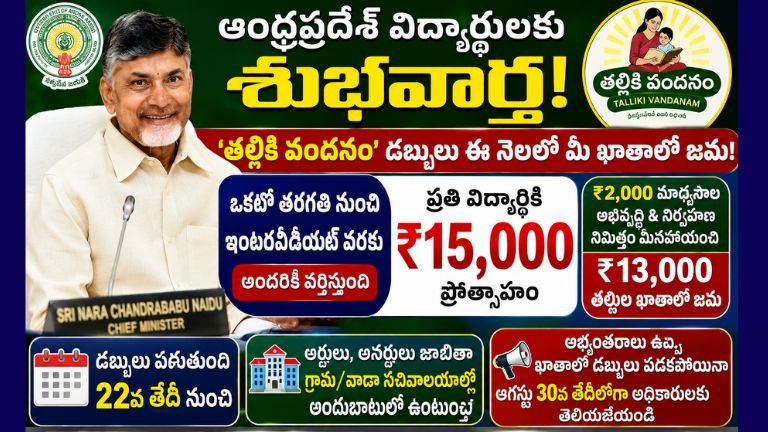
Thalliki Vandanam Scheme 2026: ₹13,000 Financial Assistance for Eligible Students in Andhra Pradesh
Good news for students and parents in Andhra Pradesh. The Thalliki Vandanam Scheme is providing financial assistance to eligible mothers or guardians of students studying from Class 1 to Class 12. The scheme is intended to reduce the financial burden of education and encourage children to continue their studies.
The Andhra Pradesh government’s official education information confirms that Thalliki Vandanam provides financial assistance of ₹15,000 per eligible student per year.
Under the current payment structure, ₹15,000 is allocated per eligible student, with ₹2,000 earmarked for school maintenance and development, resulting in ₹13,000 being credited to the eligible mother’s or guardian’s bank account. The 2026 payment process has also been reported as beginning in July, with ₹13,000 being credited directly through DBT to eligible beneficiaries.
This article explains the scheme, eligibility, payment amount, beneficiary lists, bank-account requirements, what to do if the money has not been credited, and important points parents should know.
What Is the Thalliki Vandanam Scheme?
Thalliki Vandanam is an Andhra Pradesh government education-support programme designed to provide financial assistance to mothers or guardians of eligible students.
The primary objective is to support families with the cost of educating their children and encourage students to remain in school or continue their intermediate education.
According to the Andhra Pradesh government’s education department information, the scheme provides ₹15,000 per student for eligible students, including students studying in government junior colleges at the intermediate level.
The scheme is therefore intended to provide support across a student’s school education journey, subject to the applicable eligibility conditions.
How Much Money Will the Mother Receive?
The headline amount under Thalliki Vandanam is ₹15,000 per eligible student per year.
However, the complete ₹15,000 is not necessarily transferred to the mother’s bank account.
Under the scheme’s payment structure:
- Total assistance: ₹15,000 per student
- School maintenance/development allocation: ₹2,000
- Amount credited to mother/guardian: ₹13,000
Therefore, eligible families commonly see ₹13,000 credited to the mother’s or eligible guardian’s bank account for each qualifying student.
The scheme guidelines and beneficiary records reflect the ₹13,000 amount credited to beneficiaries.
Who Can Benefit From the Scheme?
The scheme is aimed at eligible students studying from Class 1 through Intermediate/Class 12.
The Andhra Pradesh government describes Thalliki Vandanam as financial support for mothers for educating children, while the Intermediate Education Department specifically states that ₹15,000 is provided under the scheme for eligible intermediate students in government junior colleges.
Eligibility is subject to the official scheme guidelines and verification of student, parent or guardian information.
Parents should therefore check their beneficiary status instead of assuming that every student automatically qualifies.
Which Classes Are Covered?
The scheme is designed to cover students from the school level through intermediate.
The applicable range includes:
- Class 1
- Class 2
- Class 3
- Class 4
- Class 5
- Class 6
- Class 7
- Class 8
- Class 9
- Class 10
- Class 11 / Intermediate 1st year
- Class 12 / Intermediate 2nd year
The exact institutional eligibility and other conditions depend on the current government guidelines.
The official Andhra Pradesh education information confirms the scheme’s association with school education and intermediate education.
Is the Money Paid for Each Student?
Yes, the scheme is structured on a per-student basis for eligible beneficiaries.
This means that if a family has more than one eligible child, the assistance can be calculated based on the number of qualifying students, subject to the scheme’s rules.
For example, if two children in a family are eligible, the gross assistance would be calculated at ₹15,000 per student. After the ₹2,000 school-related allocation for each student, the mother’s account amount would work out to ₹13,000 per eligible student.
Parents should check the official beneficiary list and payment status to confirm the actual amount applicable to their family.
Direct Benefit Transfer
One of the important features of the scheme is the use of Direct Benefit Transfer (DBT).
Instead of distributing cash manually, the eligible amount is transferred electronically to the registered bank account of the mother or eligible guardian.
Recent reporting on the 2026 payment process stated that the government was transferring ₹13,000 to eligible beneficiaries through DBT.
This makes it particularly important for parents to ensure that their bank-account information is correct and active.
Why Is Only ₹13,000 Credited?
Some parents may wonder why the scheme is described as ₹15,000 while only ₹13,000 appears in the bank account.
The reason is the allocation of ₹2,000 toward school maintenance and development.
Therefore:
₹15,000 total assistance − ₹2,000 school-related allocation = ₹13,000 credited to the mother/guardian.
This structure is reflected in the scheme information and beneficiary records.
Parents should therefore not assume that a ₹13,000 credit means ₹2,000 has been wrongly deducted from their payment.
What Is the Purpose of the ₹2,000?
The ₹2,000 component is associated with school maintenance and development.
The idea is to ensure that a portion of the overall assistance supports educational infrastructure and maintenance rather than transferring the entire amount directly to the family.
The remaining ₹13,000 is credited to the eligible mother or guardian.
Beneficiary Lists
Another important part of the Thalliki Vandanam payment process is the preparation and publication of beneficiary lists.
Eligible and ineligible student/parent records are processed through the government education and administrative systems.
In previous beneficiary lists, records have included information such as:
- Mother or guardian name
- Student name
- Student ID
- School details
- Class
- Aadhaar-related information
- NPCI status
- Final eligibility status
- Payment amount
Published beneficiary records show eligible entries with an amount of ₹13,000 and an active NPCI status.
Parents should therefore check their local Gram/Ward Sachivalayam or the official education-related channels for their beneficiary status.
What If Your Name Is Not on the List?
If a parent’s name or child’s details do not appear in the beneficiary list, the family should not immediately assume that the application has been permanently rejected.
There can be several reasons for a record not appearing as eligible, including:
- Incorrect student information
- Aadhaar validation problems
- Bank-account issues
- NPCI mapping problems
- School data errors
- Missing information
- Eligibility-related issues
- Data-entry mistakes
Parents should approach the relevant authorities and ask them to verify the record.
The beneficiary-list documentation specifically indicates that beneficiaries with inactive NPCI status should contact their bank to link Aadhaar with the bank account where required.
What If ₹13,000 Has Not Been Credited?
If you believe that you are eligible but the amount has not reached your bank account, first check whether your name appears on the eligible list.
Then verify:
- Whether the child is correctly registered with the school.
- Whether the mother’s or guardian’s details are correct.
- Whether Aadhaar details have been validated.
- Whether the bank account is active.
- Whether Aadhaar is correctly linked with the bank account.
- Whether NPCI status is active.
- Whether there are any errors in the student’s school records.
If there is an issue, contact the appropriate school, Sachivalayam, education official or bank, depending on the nature of the problem.
Importance of NPCI Status
NPCI status is particularly important for DBT payments.
If the beneficiary’s bank account does not have the required Aadhaar/NPCI mapping, the payment may not be successfully credited.
Beneficiary-list records have specifically identified inactive NPCI cases and advised beneficiaries to contact the concerned bank for Aadhaar-bank-account linking.
Therefore, parents who are waiting for payment should not only check their bank balance. They should also verify whether their payment account is properly mapped for DBT.
What Documents May Be Important?
Parents should keep their basic documents and information ready when checking or correcting their beneficiary details.
These can include:
- Aadhaar card of the mother/guardian
- Aadhaar details of the student
- Bank passbook
- Student ID
- School admission details
- Ration card or other eligibility documents, where applicable
- Mobile number
- Parent/guardian details
The exact documents required for a correction or grievance can vary depending on the issue.
Attendance and Eligibility
Parents should also pay attention to attendance requirements.
The scheme’s implementation guidelines have included attendance-related conditions for subsequent years. Information on the scheme guidelines notes that attendance requirements can affect eligibility for future payments.
Therefore, parents should ensure that their children regularly attend school or college and that attendance records are correctly maintained by the institution.
Parents should not rely on old social-media posts for attendance rules because government conditions can be updated from one academic year to another.
Government and Private Institutions
The scheme’s implementation has included students studying in eligible recognised institutions, subject to the conditions specified in the government guidelines.
The scheme guidelines for the initial implementation described financial assistance for eligible students studying in recognised government, aided and private educational institutions from Classes 1 to 12.
However, parents should verify the current academic-year eligibility requirements with the school or official education department.
How Does the Scheme Help Families?
Education can create a significant financial burden for families.
Parents may have to spend money on:
- School-related expenses
- Books
- Uniforms
- Transportation
- Educational materials
- Examination-related expenses
- Other child-related educational needs
Financial support can help families manage some of these expenses.
The larger objective is to encourage parents to keep children in education and reduce financial barriers that can contribute to school dropouts.
The Andhra Pradesh education department identifies Thalliki Vandanam as a key scheme intended to provide direct financial support to mothers for children’s education.
Important Dates and Payment Updates
Parents should be careful when reading payment dates shared on social media.
For the 2026 payment cycle, reports indicated that payments of ₹13,000 began from July 22, with transfers taking place in stages.
However, payment schedules can vary according to beneficiary verification and processing.
Therefore, if the money has not arrived on a particular date, parents should first check their eligibility and payment status rather than assuming that they have lost the benefit.
Second-Round or Pending Payments
When a large number of beneficiaries are processed, some payments may require additional verification or correction.
Issues such as incorrect bank details, inactive NPCI mapping, student-data errors or incomplete verification can delay payments.
Some reports have discussed additional processing for beneficiaries who did not receive the first payment because of such issues.
Parents who have a genuine grievance should therefore report the problem through the appropriate official channel and retain any acknowledgement or reference number.
Beware of Fake Links
Parents should be extremely careful with websites and social-media messages claiming to provide instant Thalliki Vandanam payments.
The government does not require parents to provide sensitive banking information to random individuals through WhatsApp or social media.
Never share:
- OTP
- ATM PIN
- UPI PIN
- Debit-card PIN
- Internet banking password
- CVV
- Full banking credentials
If someone claims that a payment can be released by paying a fee, treat the message as suspicious.
Always use official government websites, schools, Sachivalayam offices or authorised government channels for verification.
How to Check Your Status
Parents who want to know whether their child is included should first approach the child’s school or their local Village/Ward Secretariat.
They can ask officials to verify the beneficiary record and check whether the student and mother/guardian details are correctly entered.
If the issue is related to the bank account, the parent should contact the concerned bank.
If it is related to school data, the school administration should verify and correct the relevant information.
This approach is safer than relying on unofficial websites claiming to provide payment status.
Frequently Asked Questions
How much is the Thalliki Vandanam benefit?
The scheme provides ₹15,000 per eligible student per year, subject to the applicable eligibility conditions.
How much is credited to the mother’s account?
Under the current structure described in the scheme guidelines, ₹13,000 is credited, while ₹2,000 is allocated for school maintenance/development.
Which students are covered?
The scheme covers eligible students from Class 1 through Intermediate/Class 12, subject to the official rules.
What should I do if money has not arrived?
Check the beneficiary list, bank account, Aadhaar linkage, NPCI status and school/student details. If there is a problem, contact the relevant school, Sachivalayam, bank or education official.
Can multiple children from one family receive the benefit?
The scheme is structured on a per-eligible-student basis. The actual amount depends on the eligibility and verification of each student.
Final Words
The Thalliki Vandanam Scheme 2026 is an important education-support initiative for eligible families in Andhra Pradesh.
The scheme provides ₹15,000 per eligible student, with ₹2,000 allocated toward school maintenance and development and ₹13,000 transferred to the eligible mother or guardian under the payment structure.
Parents should remember that payment depends on eligibility and successful verification. Having a child in school alone does not necessarily guarantee payment if there are problems with eligibility, school records, Aadhaar validation, bank details or NPCI mapping.
If the money has not been credited, parents should first check their beneficiary status and contact the appropriate official authority. In particular, an inactive NPCI status may require the beneficiary to approach the bank for Aadhaar-account linking.
The safest approach is to rely on official government information and the child’s school or local Secretariat rather than unofficial links circulating on social media.
For the latest information, parents should check the Andhra Pradesh School Education Department and their local government offices before taking any action.