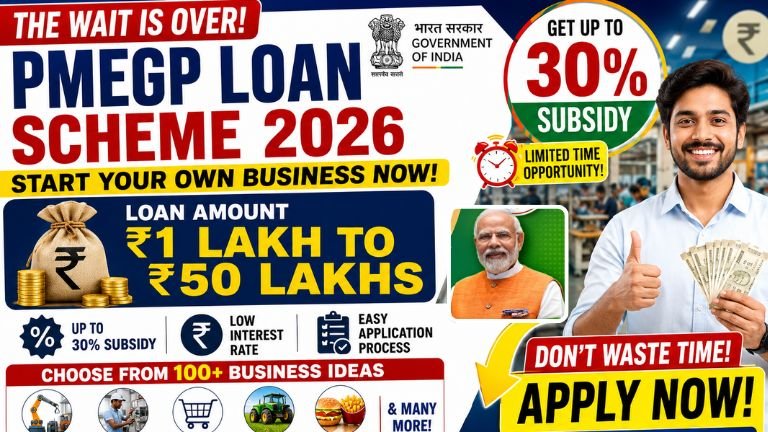
PMEGP Loan Scheme 2026: Up to ₹50 Lakh Project Cost and Government Subsidy – Eligibility, Benefits and Online Application
If you are planning to start a new small business but are worried about arranging the required investment, the Prime Minister’s Employment Generation Programme (PMEGP) can be an important government-supported financing option to explore.
PMEGP is designed to encourage self-employment and create employment opportunities by helping eligible entrepreneurs establish new micro-enterprises in manufacturing and business/service activities.
One important clarification is necessary: PMEGP does not simply provide every applicant with a ₹50 lakh loan and a flat 30% subsidy. Under the current guidelines, the maximum project cost eligible for margin-money subsidy is ₹50 lakh for manufacturing projects and ₹20 lakh for business/service projects. The subsidy rate varies according to the beneficiary category and whether the unit is located in an urban or rural area.
Eligible applicants can apply through the official PMEGP online portal.
What Is PMEGP?
PMEGP stands for Prime Minister’s Employment Generation Programme.
It is a credit-linked subsidy programme intended to promote employment through the establishment of new micro-enterprises. The scheme supports entrepreneurs who want to start eligible manufacturing, business or service activities.
Instead of providing the entire project cost as a government grant, PMEGP combines the beneficiary’s own contribution, bank finance and government margin-money subsidy.
This makes the scheme particularly useful for people who have a viable business idea but need institutional finance to establish the enterprise.
The official PMEGP guidelines state that financial assistance is available for new enterprises/units, subject to the scheme’s eligibility conditions.
PMEGP Loan 2026: How Much Financial Assistance Is Available?
The maximum project cost eligible for margin-money subsidy is currently:
- Manufacturing sector: Up to ₹50 lakh
- Business/Service sector: Up to ₹20 lakh
If the total project cost is higher than these limits, the bank may finance the additional amount, but the amount above the applicable subsidy ceiling does not receive PMEGP margin-money subsidy.
Therefore, the commonly circulated statement that “PMEGP gives a ₹50 lakh loan to everyone” is not accurate.
The actual bank loan depends on the project, applicant contribution, bank appraisal, viability and other applicable lending conditions.
How Does the PMEGP Subsidy Work?
PMEGP provides margin-money subsidy, rather than simply depositing cash into the applicant’s bank account.
For new enterprises, the current subsidy structure is based on the beneficiary category and project location.
General Category
For general-category beneficiaries:
- Urban area: 15% subsidy
- Rural area: 25% subsidy
- Beneficiary contribution: 10%
Special Category
The special category includes eligible groups such as SC, ST, OBC, minorities, women, ex-servicemen, transgender persons, differently abled persons and certain other categories specified in the guidelines.
For eligible special-category beneficiaries:
- Urban area: 25% subsidy
- Rural area: 35% subsidy
- Beneficiary contribution: 5%
These rates are specified in the revised PMEGP guidelines.
So, rather than saying that every applicant receives a 30% subsidy, it is more accurate to say that eligible beneficiaries can receive 15% to 35% margin-money subsidy, depending on category and location.
Example of PMEGP Subsidy
Suppose an eligible entrepreneur proposes a project costing ₹10 lakh.
If the applicant belongs to the general category and the project is located in a rural area, the applicable subsidy rate can be 25%.
That would mean a potential margin-money subsidy of ₹2.50 lakh, subject to the scheme rules and sanction.
If an eligible special-category applicant establishes the project in a rural area, the applicable subsidy rate can be 35%, which would correspond to ₹3.50 lakh on a ₹10 lakh eligible project cost.
The subsidy calculation is subject to the official guidelines and bank/implementing-agency process. It should not be treated as an unconditional cash payment.
Who Can Apply for PMEGP?
For new PMEGP enterprises, an individual applicant must generally be above 18 years of age.
The official guidelines state that there is no income ceiling for assistance for setting up projects under PMEGP.
Other eligible forms of applicants can also include certain institutions, self-help groups, production cooperative societies and charitable trusts, subject to the detailed conditions of the scheme.
For individuals, the important point is that the applicant should satisfy the applicable age, project, educational and other eligibility requirements.
Educational Qualification
Educational qualification requirements depend partly on the size and sector of the proposed project.
According to the PMEGP guidelines, for projects costing more than:
- ₹10 lakh in manufacturing, or
- ₹5 lakh in business/service,
the beneficiary should have passed at least Class VIII.
Therefore, people should not assume that a specific qualification such as graduation is mandatory for every PMEGP project.
At the same time, applicants should carefully verify the current guidelines before submitting their application.
Is PMEGP Available for Existing Businesses?
PMEGP primarily supports new enterprises under its new-unit component.
However, the scheme also contains a separate provision for the upgradation of existing PMEGP/REGP/MUDRA units.
The eligibility requirements for an upgradation loan are different from those for a new enterprise.
For example, the official PMEGP portal states that eligible existing PMEGP/MUDRA units must satisfy conditions relating to repayment and profitability, and Udyam Registration is mandatory for the upgradation facility.
Therefore, an existing business owner should check whether they qualify under the second-loan/upgradation component rather than applying as though they were establishing a completely new unit.
What Types of Businesses Can Be Started?
PMEGP supports a wide range of eligible activities.
Depending on the applicable negative list and sector-specific rules, entrepreneurs can consider activities in areas such as:
- Food processing
- Manufacturing
- Furniture-related businesses
- Engineering and fabrication
- Repair and service businesses
- Garment-related activities
- Small production units
- Printing and related activities
- Certain agricultural and rural industries
- Retail and service activities where permitted
- Other eligible micro-enterprises
The important point is that not every business activity is automatically eligible.
Applicants should check the current PMEGP guidelines and the applicable activity list before preparing their project proposal.
Why Is a Business Plan Important?
A PMEGP application is not simply a request for free money.
The applicant needs to propose a viable business project. The bank and implementing agency may examine the project’s feasibility, financial requirements, repayment capacity and other factors.
A good project report should explain:
- What business you want to start
- Where the business will operate
- Required machinery and equipment
- Building or rental requirements
- Raw material requirements
- Number of employees
- Expected production
- Expected sales
- Operating expenses
- Working capital requirements
- Expected profit
- Loan requirement
- Repayment capacity
A realistic project report can help the applicant explain how the proposed enterprise will operate.
PMEGP Application Process
Eligible applicants can submit a new-unit application through the official PMEGP portal.
The official portal provides an “Application For New Unit” option for applicants.
Step 1: Visit the Official PMEGP Portal
Go to the official PMEGP application portal.
Do not depend on unofficial websites or agents promising guaranteed approval.
The official portal itself warns applicants that KVIC, KVIB, DIC and Coir have not engaged private parties, middlemen, franchises or agents to promote or sanction PMEGP projects.
Step 2: Select New Unit Application
If you are starting a new eligible business, select the application option for a new unit.
The portal provides an online application form for individual applicants.
Step 3: Enter Aadhaar and Personal Details
The online form asks for applicant information, including Aadhaar details and the applicant’s name.
The application instructions indicate that the name should be entered exactly as it appears on the Aadhaar card.
Applicants should therefore make sure that their personal details are accurate before proceeding..
Step 4: Select State and District
Applicants need to select the relevant state and district and provide information regarding the sponsoring/implementing agency.
The application portal provides options for selecting the state, district and sponsoring agency.
Step 5: Enter Business Details
Provide details about the proposed enterprise.
This may include the business activity, project cost, employment generation and other information required by the application.
Make sure that the project cost matches your project report and proposed financial requirements.
Step 6: Select Financing Bank
The application form includes details for the proposed financing bank and branch.
Applicants should enter the required banking information carefully.
Step 7: Upload Required Documents
Depending on the application and category, applicants may need to submit documents such as:
- Aadhaar card
- PAN card
- Educational qualification certificate
- Passport-size photograph
- Project report
- Bank account details
- Caste/category certificate where applicable
- Special-category certificate where applicable
- Address-related documents
- Other documents requested by the implementing agency or bank
The exact document requirements can vary, so applicants should follow the instructions displayed in the official application.
Step 8: Submit the Application
After completing all sections, carefully review the information.
Check your name, Aadhaar details, address, project cost, business activity, bank details and uploaded documents.
Then submit the application.
Keep the application ID and other acknowledgment details safely for future tracking.
Official PMEGP Apply Link
Applicants should use the official government PMEGP portal rather than paying an agent to submit the application.
Official PMEGP Online Application Portal
The official PMEGP portal currently provides options for new-unit applications, registered applicants and existing-unit upgradation applications.
Does PMEGP Guarantee Loan Approval?
No.
Applying for PMEGP does not automatically mean that a bank must sanction the requested amount.
PMEGP is a credit-linked subsidy programme, meaning bank finance and subsidy are linked to the eligible project and applicable scheme conditions.
The bank evaluates the proposal and lending requirements before sanctioning the loan.
Therefore, applicants should prepare a realistic business plan and provide genuine documents.
A person should never believe anyone who says that PMEGP approval is guaranteed simply by paying a fee.
Is PMEGP Subsidy Free Money?
The subsidy is government support linked to the eligible project. It should not be understood as unrestricted cash that the applicant can simply withdraw and spend for any purpose.
The scheme operates through the banking system and margin-money subsidy mechanism.
The applicant is also required to bring their own contribution according to the applicable category.
For new enterprises, the current contribution is generally:
- 10% for general-category applicants
- 5% for eligible special-category applicants
The applicable subsidy percentage depends on category and rural/urban location.
Can Women Apply for PMEGP?
Yes.
Women are included in the special category under the PMEGP guidelines.
Eligible women entrepreneurs can therefore receive the special-category subsidy rate, subject to the scheme’s conditions.
For eligible special-category applicants, the subsidy rate is 25% in urban areas and 35% in rural areas under the current guidelines.
This can make PMEGP particularly relevant to women who want to establish eligible micro-enterprises.
Can Rural Entrepreneurs Apply?
Yes.
PMEGP specifically supports employment generation in rural as well as urban areas.
In fact, the subsidy percentage is higher for eligible projects located in rural areas.
For general-category applicants, the current rural subsidy rate is 25%, compared with 15% in urban areas.
For eligible special-category applicants, the rural rate is 35%, compared with 25% in urban areas.
Important PMEGP Fraud Warning
Applicants should be extremely careful about fake PMEGP websites, WhatsApp messages and agents.
The official PMEGP portal specifically warns that KVIC, KVIB, DIC and Coir have not engaged private parties, middlemen, franchises or agents for promoting or sanctioning PMEGP projects or financial assistance.
If somebody tells you:
“Pay ₹5,000 and your PMEGP loan will definitely be approved,”
or
“Pay money and we will guarantee the subsidy,”
you should be extremely cautious.
Never share your banking PIN, OTP, password or other confidential financial information with unknown persons.
Always verify information through the official PMEGP portal or the appropriate government implementing agency.
PMEGP Loan Scheme 2026: Key Points at a Glance
| Feature | Details |
|---|---|
| Scheme | Prime Minister’s Employment Generation Programme |
| Purpose | New micro-enterprise and employment generation |
| Minimum age | Above 18 years |
| Manufacturing project ceiling for subsidy | ₹50 lakh |
| Business/Service project ceiling for subsidy | ₹20 lakh |
| General subsidy | 15% urban / 25% rural |
| Special-category subsidy | 25% urban / 35% rural |
| General-category contribution | 10% |
| Special-category contribution | 5% |
| New project | Eligible subject to scheme rules |
| Application | Online through official PMEGP portal |
| Bank finance | Subject to bank appraisal and sanction |
The figures above are based on the current PMEGP guidelines and official portal information.
Final Conclusion
The PMEGP Loan Scheme 2026 can be a useful option for aspiring entrepreneurs who want to establish an eligible micro-enterprise with bank finance and government margin-money subsidy.
However, applicants should understand the scheme correctly.
PMEGP is not a scheme where everyone automatically receives ₹50 lakh and a flat 30% subsidy. The current guidelines provide for project costs eligible for margin-money subsidy of up to ₹50 lakh in manufacturing and ₹20 lakh in business/service activities. Subsidy rates vary from 15% to 35% depending on the beneficiary category and whether the project is located in an urban or rural area.
Applicants above 18 years can apply for eligible new projects, subject to the detailed eligibility requirements.
The most important step is to choose a realistic business idea, prepare a proper project report, calculate the required investment carefully and submit the application through the official PMEGP portal.
If you are planning to start a manufacturing unit, service business or another eligible micro-enterprise, PMEGP may help reduce the initial financial burden through its credit-linked subsidy mechanism.
Before applying, always check the latest official guidelines, because scheme conditions, eligible activities and application procedures can change.
Official PMEGP Application
For applicants who want to start a business, the best approach is not to rush into borrowing money. First identify a business with genuine demand, calculate the expected monthly expenses and revenue, prepare a realistic project report and then explore PMEGP and bank finance.
A government subsidy can reduce the financial burden, but the business itself still needs to be profitable and capable of repaying the bank loan.