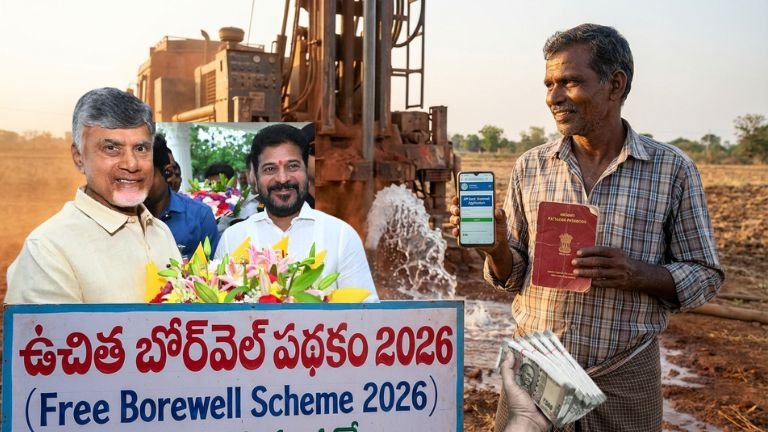
Free Borewell Scheme 2026: Bringing Water and Joy to Farmers’ Fields
Water is the lifeblood of agriculture. For decades, marginal and small-scale farmers have depended entirely on unpredictable monsoons to irrigate their crops. But in 2026, a wave of transformation is sweeping across rural landscapes. Farmers are finally receiving 100% free borewells from the government, and the joy of seeing fresh, abundant water gushing into their dry fields is truly a sight to behold.
If you are a farmer struggling with water scarcity, your days of waiting for the rain might be over. Various state governments, particularly across agricultural hubs like Andhra Pradesh, Telangana, and Karnataka, are aggressively rolling out free borewell drilling schemes to empower farmers.
Here is your complete, SEO-optimized guide on how the Free Borewell Scheme 2026 works, who is eligible, and exactly how you can apply to transform your farming output.
What is the Free Borewell Scheme 2026?
The Free Borewell Scheme is a targeted government initiative designed to provide guaranteed irrigation facilities to small and marginal farmers. Under this program, the government bears the complete cost of drilling the borewell, installing the casing pipe, and, in many cases, providing the pump set and electrical connection.
The Impact: Why Farmers Are Celebrating
The implementation of these schemes in 2026 has been a game-changer. Farmers who previously could only grow one crop a year due to water limitations are now cultivating two to three crops.
-
Increased Income: Guaranteed water means higher crop yields and the ability to grow cash crops.
-
Debt Relief: Farmers no longer need to take high-interest private loans to drill borewells.
-
Sustainable Livelihood: The joy visible on the faces of these farmers stems from the financial security that year-round irrigation brings to their families.
Major State-Specific Free Borewell Initiatives
While the core concept remains the same, the scheme operates under different names depending on your state. Knowing your specific state’s scheme is crucial for a successful application.
1. Andhra Pradesh: YSR Jala Kala Scheme
In Andhra Pradesh, the “YSR Jala Kala” scheme is setting the benchmark for 2026. The government aims to drill free borewells for eligible farmers, providing them with a lifeline for their parched lands. If a borewell fails, the government even covers the cost of drilling a second one.
2. Karnataka: Ganga Kalyana Scheme
For farmers in Karnataka, the “Ganga Kalyana Scheme” run by the Karnataka Minority Development Corporation (KMDC) and other state departments provides free borewells or open wells with pump sets to farmers belonging to minority communities, SC/ST, and backward classes.
3. Telangana: Free Borewell & Power Subsidy
Telangana continues to support its farmers through localized free drilling initiatives linked with the state’s robust 24/7 free agricultural electricity schemes, ensuring that once the water is struck, farmers don’t pay a rupee to pump it.
Eligibility Criteria: Can You Apply?
To ensure the benefits reach the most vulnerable, governments have set specific eligibility guidelines. While these can vary slightly by state, the standard criteria for 2026 include:
-
Land Ownership: The farmer must own contiguous agricultural land (usually between 2.5 to 5 acres).
-
Group Applications: If a single farmer does not have the required land block, a group of adjacent farmers can apply together.
-
Prior Borewells: The land must not already have an existing functional borewell.
-
Category: Priority is often given to Small/Marginal farmers, SC/ST categories, and women farmers.
-
Hydrogeological Clearance: A ground-water survey will be conducted by government geologists to confirm the feasibility of striking water before drilling begins.
Required Documents for the 2026 Scheme
Before you start your application, keep the following documents ready and digitized:
-
Aadhaar Card: For identity verification.
-
White Ration Card: To prove income status.
-
Land Documents: Pattadar Passbook, Title Deed, and Adangal/Pahani (1B) copies.
-
Caste Certificate: If applying under SC/ST/OBC/Minority quotas.
-
Bank Passbook Copy: First page showing the account number and IFSC code.
-
Passport Size Photographs.
Step-by-Step Application Process
Getting your free borewell involves a straightforward process. Here is how you can apply today:
Option 1: Online Application
-
Visit the Official Portal: Go to your state’s specific scheme website (e.g., the YSR Jala Kala portal for AP or the Nadakacheri/KMDC portal for Karnataka).
-
Register/Login: Create a profile using your Aadhaar number and OTP verification.
-
Fill the Form: Navigate to the ‘Apply for Free Borewell’ section and fill in your land and personal details accurately.
-
Upload Documents: Upload scanned copies of your land passbook, Aadhaar, and other required documents.
-
Submit: Hit submit and note down your Application Reference Number for future tracking.
Option 2: Offline Application (Village Secretariats)
If you are not comfortable applying online, the government has made offline applications highly accessible in 2026:
-
Visit your local Gram Panchayat, Village Secretariat (Grama Sachivalayam), or Rythu Bharosa Kendra (RBK).
-
Request the Free Borewell Scheme Application Form.
-
Fill out the form and attach physical photocopies of all required documents.
-
Submit the form to the Village Revenue Officer (VRO) or the designated agricultural assistant. They will upload the details online on your behalf.
What Happens After You Apply?
Once applied, the application goes through a verification process by the VRO/Tahsildar. Following approval, a qualified hydrogeologist will visit your field to conduct a groundwater survey and mark the drilling point. Finally, the government-contracted drilling agencies will arrive with their rigs to drill the borewell at zero cost to you.
Telangana Farmers Free Borewell
The 2026 Free Borewell schemes are wiping the tears of debt and drought from the faces of farmers, replacing them with smiles of prosperity. Do not let your crops dry up while this government subsidy is available. Gather your documents, visit your nearest village secretariat or official online portal, and apply today!