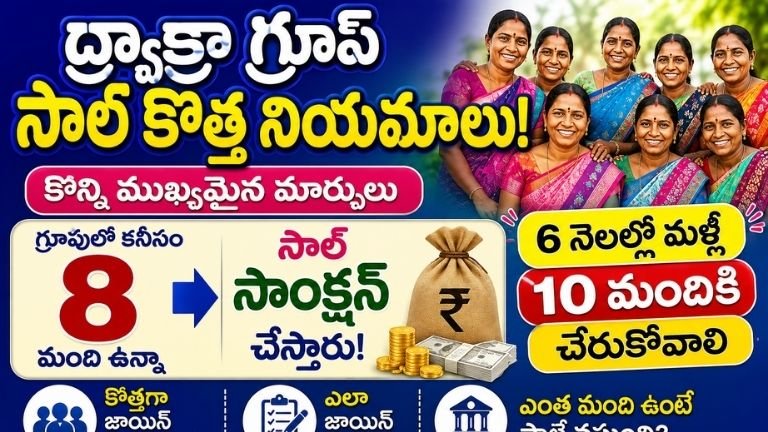
SHG / DWCRA Group Loan New Rules: Can 8 Members Get a Loan? Complete Guide
Self-Help Groups (SHGs), commonly known as DWCRA groups in many parts of India, play an important role in helping women access affordable credit and start or expand small businesses. Through these groups, members can save money regularly, obtain loans, and access financial support for activities such as agriculture, livestock, tailoring, small shops, food businesses and other income-generating activities.
Recently, there has been considerable discussion about changes in the minimum number of members required in a group for obtaining a loan. In particular, many women want to know whether a group with 8 members can receive a loan, whether 10 members are still compulsory, and what happens if the group has fewer members than before.
This article explains the information in a simple manner and highlights the important conditions that members should understand before applying for a group loan.
Important: Loan eligibility, group-size requirements, repayment conditions and sanction rules can vary depending on the bank, SHG programme, state-level implementation and current official guidelines. Members should confirm the applicable rules with their SHG federation, bank branch or concerned government department before relying on any particular loan amount or condition.
What Is a DWCRA or SHG Group?
A Self-Help Group is a small group of people who come together to save money regularly and support one another financially. In many areas, women’s SHGs are connected with banks and government-supported programmes.
DWCRA is a term commonly associated with women’s self-help and livelihood groups in several parts of India. The basic idea is to encourage women to work together, maintain regular savings, build financial discipline and become eligible for institutional credit.
Instead of approaching a bank individually, members can access credit through the group structure. The group maintains records of savings, meetings, loans and repayments.
The group system also encourages members to develop a habit of regular saving and timely repayment.
Why Is the Number of Members Important?
One of the most common questions among SHG members is:
“How many members should be there in our group to get a loan?”
Traditionally, many SHG structures have operated with around 10 to 20 members, depending on the programme and local rules. Therefore, members often assume that exactly 10 people must be present before any loan can be considered.
However, the minimum and maximum group size can depend on the particular programme and implementing agency.
The information currently being discussed is that in certain circumstances a group with at least 8 members may also be considered for loan sanction, subject to applicable conditions.
This does not mean that every group with eight members will automatically receive a loan. Banks generally consider several other factors before sanctioning credit.
Can an 8-Member Group Get a Loan?
According to the information being circulated, groups that have at least 8 members may be eligible for consideration for a loan under the revised arrangement.
This is particularly important for groups that previously struggled to maintain the required membership of 10.
For example, suppose a women’s SHG originally had 10 members. Later, two members leave the group for personal reasons. The group now has only eight members.
Under the discussed change, such a group may still be considered for a loan instead of being immediately disqualified merely because its membership has fallen from 10 to 8.
However, there is an important condition.
The group may be required to increase its membership back to 10 members within six months.
Therefore, members should not misunderstand the rule as meaning that eight members are permanently sufficient for every purpose.
The eight-member provision can be understood as an opportunity to avoid stopping the group’s financial activities merely because the membership temporarily falls.
The Six-Month Condition
The six-month condition is one of the most important points members should understand.
If a group is functioning with eight members and receives consideration for a loan, the group may have to add additional members within the specified period.
For example:
- Existing members: 8
- Additional members required: 2
- Target membership: 10
- Suggested period: 6 months
Therefore, the group should make efforts to identify eligible women who are willing to become members.
The purpose of such a condition is to ensure that the group eventually returns to the required strength and continues functioning as a proper SHG.
Members should maintain proper documentation when new members are added.
What About Existing DWCRA Groups?
Existing groups should first check their current membership status.
If the group has 10 members, there may be no issue regarding the basic membership count, provided all other requirements are fulfilled.
If the group currently has eight members, members should not assume that they are automatically eligible for a loan simply because of the new information.
They should check:
- Whether their group is officially registered or recognized.
- Whether the group has an active bank account.
- Whether savings are being maintained regularly.
- Whether meetings are being conducted properly.
- Whether previous loans have been repaid.
- Whether records are up to date.
- Whether the bank has accepted the group for credit linkage.
- Whether the six-month membership condition applies to their particular programme.
These factors can be important when a bank evaluates an SHG loan application.
Previous Loans Must Be Cleared
Another important point is the status of previous loans.
If a group already has an outstanding loan, members may need to ensure that the previous loan obligations are properly settled before receiving a new loan, depending on the applicable lending rules.
A group should therefore maintain a clear record of:
- Previous loan amount
- Amount repaid
- Remaining balance
- Repayment dates
- Bank statements
- Savings records
- Group meeting records
Good repayment history can strengthen the group’s financial credibility.
Members should never assume that a new loan will be sanctioned simply because the group has eight or ten members.
The bank can examine the group’s financial history and other eligibility criteria.
Can New Members Join an Existing Group?
Another common question is whether a woman who is not currently part of a DWCRA/SHG can join an existing group.
In general, membership depends on the group’s structure and the rules of the relevant SHG programme.
Under the information discussed here, a new group or group formation may be considered with a minimum of eight members in certain circumstances.
However, if the group begins with eight members, it may have to increase its strength to 10 members within the prescribed six-month period.
Women who want to join should therefore speak with the existing group members and the concerned SHG/federation representative before completing membership formalities.
How Can a Woman Join an SHG?
The process can vary from one state or programme to another, but a woman interested in joining an SHG can generally follow these steps.
Step 1: Identify a Local SHG
First, find out whether there is an existing women’s SHG in your village or locality.
You can approach:
- Existing SHG members
- Village-level organizations
- SHG federation representatives
- Local officials
- Women development departments
- Bank officials
Step 2: Ask About Membership
Talk to the group members and ask whether new membership is currently open.
Not every group may be accepting new members at all times.
Step 3: Check Eligibility
The concerned organization or group representative can explain the eligibility requirements and documents required for joining.
Step 4: Complete Membership Formalities
If you are eligible and the group agrees to include you, complete the required membership process.
The exact procedure may differ depending on the state and implementing agency.
Step 5: Start Regular Savings
SHGs generally operate through regular savings. Members may be required to contribute a fixed amount according to the group’s rules.
Regular saving is one of the basic principles of SHG functioning.
Step 6: Attend Group Meetings
Members should participate regularly in group meetings and maintain proper records.
Regular participation can be important for the group’s functioning and financial discipline.
How Is an SHG Loan Different From an Individual Loan?
An SHG loan is linked to the group’s financial structure rather than simply being based on one individual’s income.
The group operates collectively, maintains savings and records, and deals with the financial institution according to the applicable lending arrangement.
This can provide women with access to institutional credit even when they may not have the same financial profile as an individual borrower.
However, members should remember that a loan is not free money.
It must be repaid according to the agreed schedule.
What Does the Bank Check Before Sanctioning a Loan?
The number of members is only one part of the process.
A bank may consider several aspects of the group before sanctioning a loan.
These may include:
1. Group Activity
The bank may check whether the group is genuinely functioning.
2. Savings History
Regular savings can demonstrate financial discipline.
3. Meeting Records
The group should maintain proper records of its meetings and decisions.
4. Previous Loan Repayment
If the group has borrowed previously, repayment performance can be important.
5. Bank Account
The SHG should have the appropriate bank account and required documentation.
6. Financial Records
Books, savings records and loan registers may be examined.
7. Credit Linkage
The group may need to satisfy the relevant requirements for bank linkage.
8. Purpose of the Loan
Depending on the loan product, the bank may ask how the borrowed money will be used.
Therefore, 8 members alone do not guarantee loan approval.
What If the Group Has 10 Members?
If your group already has 10 members, you should continue maintaining the group’s records and financial discipline.
Having 10 members can satisfy the membership requirement in programmes where 10 is the prescribed group size, but other eligibility conditions can still apply.
Members should therefore avoid thinking:
“We have 10 members, so the loan must definitely be sanctioned.”
Loan sanction remains subject to the rules and assessment of the concerned financial institution and programme.
What If a Member Leaves the Group?
Sometimes a member may leave because of relocation, family circumstances, financial difficulties or other reasons.
If this reduces the group’s strength to eight, members should immediately discuss the situation with the relevant SHG representative.
Instead of allowing the group to become inactive, the group may be able to continue functioning subject to the applicable rules.
If the discussed six-month condition applies, the group should make arrangements to add two eligible members and return to the required strength of 10.
Why Maintaining 10 Members Can Still Be Important
Even when eight members may be permitted under certain circumstances, maintaining 10 members can be beneficial.
A stronger membership base can help the group:
- Continue regular meetings
- Maintain savings
- Share responsibilities
- Conduct group activities
- Manage internal lending
- Maintain continuity when a member leaves
- Meet programme requirements
Therefore, members should view the eight-member provision as a possible flexibility rather than a reason to permanently reduce group membership.
Documents Members Should Keep Ready
The exact document requirements can vary, but members should generally keep their group records organized.
Important records may include:
- SHG/group registration details
- Bank account information
- Member details
- Savings records
- Meeting register
- Loan register
- Previous loan repayment records
- Identity documents where required
- Address-related documents where applicable
- Group resolutions
- Other documents requested by the bank or implementing authority
Keeping records updated can make the process smoother.
Beware of False Loan Messages
Whenever new SHG loan rules are announced or discussed online, fake messages can also circulate.
Members should be careful about messages promising:
- Guaranteed loans
- Huge amounts without eligibility
- Instant approval
- No repayment
- Loans without documentation
- Loans in exchange for advance fees
Never share OTPs, PINs, passwords or banking credentials with unknown people.
If somebody asks for money in exchange for guaranteed loan sanction, verify the claim directly with the concerned bank or government office.
Final Takeaway
The key point from the current information is that some SHG/DWCRA groups with a minimum of eight members may be considered for loans under certain arrangements, instead of requiring exactly 10 members in every situation.
However, there can be a condition that the group must increase its membership to 10 members within six months.
Existing groups should also check their previous loan status and ensure that their financial records, savings, meetings and repayment history are properly maintained.
Women who want to newly join a DWCRA/SHG should contact an existing local group or the concerned SHG authority and confirm the current membership and loan rules applicable to their area.
Most importantly, do not judge loan eligibility only by the number of members. Bank linkage, repayment history, savings, group activity, documentation and programme-specific requirements can also play an important role.
If you want to know the exact procedure for joining a DWCRA/SHG group, the current minimum number of members, loan eligibility, required documents and how to apply, check with your local SHG federation or the concerned bank branch for the latest official information.