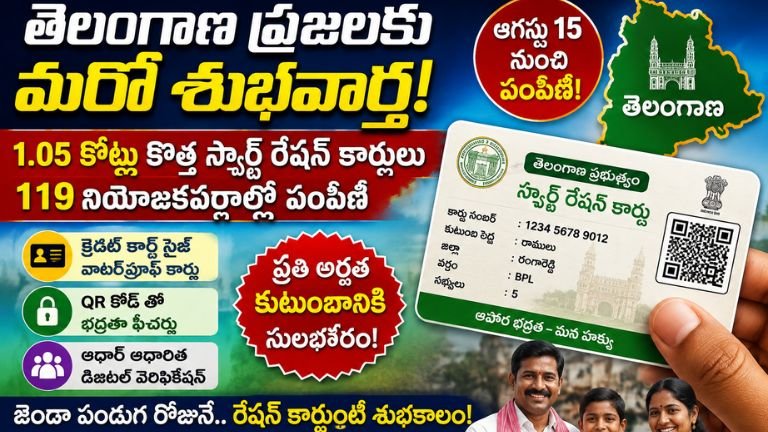
Telangana New Smart Ration Card 2026: 1.05 Crore PVC Cards, QR Code, Benefits and Distribution Details
The Telangana government has moved ahead with the distribution of new smart ration cards for eligible families across the state. The new cards are being introduced in a modern PVC format, replacing the traditional paper-style ration card appearance and making the card easier to carry and preserve.
According to recent reports, the state has planned the distribution of around 1.05 crore new smart ration cards across Telangana, covering eligible families in all 119 Assembly constituencies. The distribution programme began around Independence Day, with ministers, MLAs, MPs, public representatives and officials participating in programmes in different constituencies.
The new card format has attracted significant attention because of its compact design, improved durability and digital features. Reports indicate that the card includes a QR code and other security-related elements.
However, people should be careful about social-media claims suggesting that scanning the QR code will automatically reveal every detail of a family. That specific functionality should not be treated as officially confirmed unless it is clearly stated by the Telangana government or Civil Supplies Department.
Telangana Smart Ration Card 2026 – Overview
The new ration card initiative is connected with Telangana’s food-security and Public Distribution System.
| Particular | Details |
|---|---|
| State | Telangana |
| Department | Consumer Affairs, Food & Civil Supplies Department |
| Card Type | New PVC / Smart Ration Card |
| Reported Coverage | Around 1.05 crore cards |
| Assembly Constituencies | 119 |
| Main Purpose | Food-security and welfare identification |
| Format | Compact PVC-style card |
| Reported Feature | QR code |
| Distribution | Through statewide constituency-level programmes |
| Beneficiaries | Eligible ration-card families |
The Telangana Civil Supplies Department is responsible for issuing ration cards to eligible families and implementing the state’s Public Distribution System.
What Is the New Telangana Smart Ration Card?
The new smart ration card is a modernised physical format of the ration or food-security card intended to make the document easier for beneficiaries to carry and maintain.
Traditional paper documents can become damaged, torn or difficult to preserve after years of use. A PVC-style card is more durable and resembles the size and appearance of commonly used identity or payment cards.
The new format is expected to make it easier for beneficiaries to keep their ration-card information safely in their wallet or purse.
The card is associated with the state’s Public Distribution System, through which eligible beneficiaries receive subsidised food grains and other applicable benefits.
Telangana already operates an Aadhaar-enabled Public Distribution System through its official AePDS platform. The government portal provides information about ration cards, beneficiaries, fair-price shops and PDS transactions.
1.05 Crore Smart Ration Cards Reported
One of the biggest points of interest is the reported scale of the distribution.
Recent reports stated that the Telangana government planned to distribute approximately 1.05 crore new smart ration cards to eligible families across the state. The programme was reported to cover all 119 Assembly constituencies.
This is a large-scale exercise because ration cards are closely connected with food-security benefits and several welfare programmes.
The reported distribution is not simply limited to Hyderabad or major cities. The programme is intended to reach eligible beneficiaries throughout Telangana.
Distribution Across 119 Constituencies
Telangana has 119 Assembly constituencies, and reports indicate that the new card distribution programme has been organised across all of them.
Local public representatives and government officials are expected to participate in distribution activities.
Depending on the constituency and local arrangements, beneficiaries may receive their cards through designated government programmes, camps or other officially organised distribution mechanisms.
People should therefore pay attention to announcements from their local district administration, Civil Supplies Department and local authorities.
What Makes the New Card Different?
The biggest visible difference is the physical format.
The new card is designed as a compact PVC-style card rather than a conventional paper document.
This provides several practical advantages.
Durable Design
PVC cards are generally more resistant to ordinary handling, folding and moisture than paper documents.
A durable card can be useful for families who need to carry their ration-card information regularly.
Compact Size
The card is designed to be similar in size to other cards commonly carried in a wallet.
This can make storage and carrying more convenient.
Digital Identification Features
Reports about the new cards mention a QR code and other security features.
QR technology can potentially help connect a physical card with digitally stored information or verification systems.
However, beneficiaries should wait for official instructions before assuming exactly what information can be accessed by scanning the QR code.
QR Code on the New Ration Card
The QR code is one of the most discussed features of the new smart ration card.
A QR code is a machine-readable code that can be scanned using a compatible device.
In government systems, QR codes can be used for identification, verification, record retrieval or linking a physical document with a digital database.
However, there is an important distinction between having a QR code and what information that QR code actually provides.
Social-media posts may claim that scanning the QR code will display the complete information of every family member or all household details.
At present, such claims should be treated carefully unless they are supported by an official Telangana government notification or Civil Supplies Department instruction.
The safe interpretation is that the QR code is a digital/security feature associated with the card. The exact data accessible through it depends on the government’s backend system, authentication requirements and official implementation.
Will the QR Code Show All Family Details?
This is one of the most common questions about the new card.
The answer should be given carefully.
A QR code can technically link to information stored in a database, but that does not mean every person who scans it can automatically see sensitive household information.
Government databases normally require appropriate access controls.
Therefore, beneficiaries should not assume that the QR code publicly displays complete household information.
If the government later publishes detailed instructions explaining the QR-code functionality, those instructions should be followed.
Until then, social-media videos and forwarded messages should not be treated as official technical documentation.
Why Is Telangana Introducing Smart Cards?
Modernising the ration-card system can provide several benefits.
A digital and durable card can make beneficiary identification easier and reduce dependence on damaged or outdated paper documents.
It can also support the broader modernisation of the Public Distribution System.
Telangana has already been using an Aadhaar-enabled PDS system. The official AePDS portal provides transaction and card-related information for the state’s food-distribution system.
The government has also previously discussed broader digital family-card concepts covering multiple welfare services.
In September 2024, the Telangana government announced plans for a One State – One Digital Card concept, with the proposed card intended to help families access ration, healthcare and other welfare services.
That earlier proposal is different from the current PVC ration-card distribution and should not automatically be described as the same programme.
Relationship With the Public Distribution System
The ration card is closely connected with Telangana’s Public Distribution System.
The Civil Supplies Department is responsible for issuing ration cards to eligible families and implementing the e-PDS system through fair-price shops.
The official AePDS portal provides live or recently refreshed statistics about cards, beneficiaries and PDS transactions.
Through the PDS, eligible families can receive their entitled subsidised food grains from authorised fair-price shops.
The new PVC card therefore serves as an important physical document connected with the beneficiary’s PDS records.
Who Is Eligible for a New Ration Card?
The smart-card distribution should not be understood as a completely separate welfare scheme where every citizen automatically receives a card.
The key requirement remains eligibility under the state’s ration-card and food-security system.
The Telangana Civil Supplies Department is responsible for issuing ration cards to eligible families.
People who have recently applied for a ration card, had family-member changes, or have pending corrections should check their status through the appropriate official Civil Supplies channels.
Existing beneficiaries should also ensure that their family details are correctly recorded.
What Information May Be Associated With the Card?
The exact design and information printed on the new card may vary according to the government’s final implementation.
Reports about the new smart cards mention identifying information and QR-based features.
Generally, ration-card systems may contain information related to:
- Ration-card number
- Household details
- Family members
- Beneficiary category
- PDS entitlement
- Aadhaar-linked information where applicable
- Fair-price-shop information
- Digital database references
Not all database information necessarily needs to be printed on the physical card.
This distinction is important because the physical card and the government database are two different components of the system.
What Should Beneficiaries Do?
Beneficiaries do not need to panic or rush to unofficial websites because of social-media messages about the new card.
Instead, they should follow official instructions from the Civil Supplies Department and district administration.
If a beneficiary has been selected for distribution, they should:
- Check the official announcement for their area.
- Confirm their ration-card details.
- Carry the required identification documents if instructed.
- Attend the designated distribution programme or collection point.
- Check the printed details on the card.
- Report any spelling or family-member errors.
- Keep the card safely after receiving it.
- Avoid sharing photographs of the card publicly if they expose sensitive information.
What If There Is an Error on the Card?
Beneficiaries should carefully check their card after receiving it.
Common errors can include:
- Incorrect spelling of a name
- Wrong family-member details
- Incorrect ration-card number
- Address-related errors
- Missing family members
- Incorrect category information
If any information is wrong, the beneficiary should approach the appropriate Civil Supplies office or authorised service channel.
Telangana district government portals list services such as ration-card mutations, member addition, member migration, household-head modification, transfer and new ration-card issuance.
Can New Ration Cards Still Be Applied For?
The availability of new applications, corrections and other services depends on the current government process.
Telangana district Civil Supplies information lists services including the issue of new ration cards, ration-card mutations and other modifications.
People who do not have a ration card but believe they are eligible should use the official Civil Supplies or MeeSeva route rather than relying on private websites.
Application availability and eligibility rules can change, so applicants should check the latest official instructions.
Is the New Card the Same as Aadhaar?
No.
The smart ration card and Aadhaar card are different documents.
Aadhaar is a national identity document issued through UIDAI, while the ration card is connected with the state’s food-security and Public Distribution System.
Telangana’s PDS uses Aadhaar-enabled authentication and related digital systems, but the ration card itself remains a separate welfare document. Telangana’s official One Nation One Ration Card information explains that Aadhaar can be seeded with ration-card records to help beneficiaries access subsidised food grains.
Is the Smart Card an ATM Card?
No.
Although the new PVC ration card may look similar in size to a bank or ATM card, it is not a banking card.
It cannot be used to withdraw money from an ATM.
Its purpose is connected with ration-card identification, food-security benefits and the Public Distribution System.
The card’s physical design is primarily intended to make it convenient and durable for beneficiaries.
Important Warning About Fake Links
Whenever a major government scheme or card distribution programme becomes popular on social media, fake application links can also appear.
Beneficiaries should be especially careful with websites asking for:
- OTP
- ATM PIN
- UPI PIN
- Internet banking password
- Full debit-card information
- Unnecessary processing fees
Government officials generally do not require beneficiaries to share confidential banking credentials through WhatsApp or social-media messages.
For ration-card services, use official Telangana government websites, Civil Supplies services, MeeSeva or the appropriate district administration.
Official Telangana PDS Portal
The Telangana government operates the Aadhaar-enabled Public Distribution System (AePDS) portal.
The official portal provides PDS-related information and statistics and is operated by the Food, Civil Supplies and Consumer Affairs Department, Government of Telangana.
Official AePDS portal: Telangana AePDS – Government Portal
For ration-card services, district government portals also direct citizens to Telangana’s Civil Supplies and MeeSeva systems.
Frequently Asked Questions
What is the Telangana Smart Ration Card 2026?
It is a new PVC-style ration-card format being introduced for eligible families under Telangana’s food-security and Public Distribution System.
How many smart ration cards are being distributed?
Recent reports put the planned distribution at approximately 1.05 crore cards across Telangana.
How many constituencies are covered?
The reported programme covers all 119 Assembly constituencies of Telangana.
Is the new ration card made of PVC?
Reports describe the new cards as PVC-style, compact and more durable than traditional paper-format cards.
Does the new card have a QR code?
Reports about the new smart ration cards mention QR-code and security features.
Can anyone scan the QR code and see the family’s complete information?
This should not be assumed. The exact information accessible through the QR code depends on the government’s digital system and access controls. Claims that the QR code automatically reveals all household information should be verified against official instructions.
Is the smart ration card an Aadhaar card?
No. It is a ration/PDS-related card and is separate from Aadhaar.
Is it an ATM card?
No. It is not a banking or ATM card.
What should I do if my family details are incorrect?
Contact the appropriate Telangana Civil Supplies or authorised service centre and request the required correction or mutation.
Where can I check PDS information?
The official Telangana AePDS portal provides PDS-related information and statistics.
The introduction of new PVC-style smart ration cards is an important development in Telangana’s Public Distribution System.
Recent reports indicate that the state is rolling out approximately 1.05 crore new smart ration cards across 119 Assembly constituencies, with the distribution programme beginning around Independence Day 2026.
The new card format is designed to be more convenient and durable, and reports indicate that it includes a QR code and other security features.
At the same time, beneficiaries should distinguish between confirmed information and social-media claims. In particular, the statement that scanning the QR code will reveal every detail of a household has not been established here as an official government specification.
The Telangana Civil Supplies Department remains the key authority for ration-card issuance and PDS implementation, while the official AePDS portal provides information about the state’s ration-card and food-distribution system.
Beneficiaries should therefore rely on official government announcements, district administration notices and authorised Civil Supplies services for information about card distribution, corrections and applications.
The new PVC card may look simple, but its importance is much greater: it is intended to provide eligible families with a more durable and modern physical document connected to Telangana’s digital food-security system.