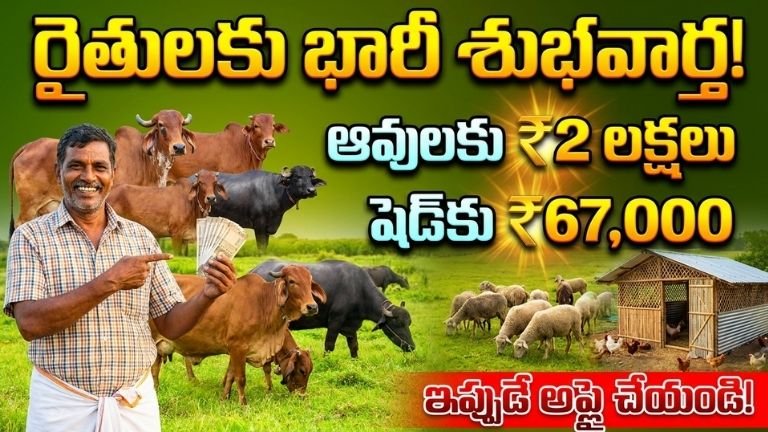
Empowering Rural Livelihoods: Your Complete Guide to the 2026 Livestock and Shed Subsidies z1
The agricultural landscape in 2026 is witnessing a transformative shift. Recognizing that livestock is the most reliable “insurance” for a farmer, the government has officially released a massive funding package to support animal husbandry.
Whether you are an aspiring dairy entrepreneur or a traditional farmer looking to modernize, the current schemes offering Rs. 2,00,000 for cattle procurement and Rs. 67,000 for shed construction are designed to change your financial trajectory. This comprehensive guide details how to navigate these applications and secure your funding.
The Rs. 2 Lakh Subsidy: Boosting Dairy Production
Dairy farming is no longer just a side business; it is a primary source of daily liquid cash. To encourage farmers to shift toward high-yielding breeds, the government is providing financial assistance of up to Rs. 2 Lakh.
Key Features of the Cattle Subsidy:
-
Breed Focus: The subsidy prioritizes high-yielding indigenous breeds (like Gir, Sahiwal, and Tharparkar) and improved crossbreeds (like HF or Jersey).
-
Unit Size: This amount is typically designed to help a farmer establish a “Mini Dairy Unit” consisting of 2 to 4 milch animals.
-
Fund Breakdown: Usually, this is a subvented loan-cum-subsidy model. Depending on the state and your category (General/OBC/SC/ST), the subsidy component can range from 25% to 50% of the total unit cost.
Why This Matters:
With milk prices stabilizing at higher rates in 2026, owning just two high-quality cows can provide a net monthly profit of ₹15,000–₹22,000 after expenses. This subsidy removes the “entry barrier” for small farmers who cannot afford the high upfront cost of quality livestock.
Infrastructure Grant: Rs. 67,000 for Livestock Sheds
Proper housing is the most neglected aspect of Indian livestock farming. Poor ventilation and damp floors lead to a 30% drop in productivity and high mortality rates. To solve this, the Rs. 67,000 shed construction grant has been introduced.
Use Cases for the Shed Grant:
-
Sheep and Goat Units: Construction of raised-floor sheds that keep animals dry and prevent hoof diseases.
-
Poultry Rearing: Building secure, predator-proof enclosures with proper ventilation for desi or broiler chickens.
-
Cattle Protection: Modernizing existing cow sheds with concrete flooring and proper drainage systems to make waste management easier.
Eligibility Criteria: Can You Apply?
To ensure the funds reach the grassroots level, the 2026 guidelines have specific eligibility requirements:
-
Farmer ID: You must have a registered Farmer ID (e.g., FRUITS ID in Karnataka, Rythu Bharosa ID in AP/Telangana).
-
Land Ownership: You must possess enough land to house the animals and, ideally, grow a small amount of green fodder.
-
Residency: You must be a permanent resident of the state where you are applying.
-
Age: Applicants must be between 18 and 60 years old.
-
Training (Optional but Preferred): Farmers who have completed a 2-day or 5-day training course in Animal Husbandry are often given top priority.
Essential Documentation Checklist
Before heading to the portal, scan and keep the following documents ready:
| Document | Purpose |
| Aadhaar Card | Identity and Address verification. |
| Pahani/RTC/Land Record | Verification of available space for farming. |
| Bank Passbook | For Direct Benefit Transfer (DBT) of the subsidy. |
| Caste Certificate | To claim higher subsidy percentages (if applicable). |
| Training Certificate | Increases chances of quick approval. |
| Passport Size Photo | Required for the application form and animal insurance. |
Step-by-Step Application Process
For the Cow/Buffalo Purchase (Rs. 2 Lakh):
-
Visit the NLM Portal: Go to the National Livestock Mission (NLM) portal or your state’s Animal Husbandry Department website.
-
Online Registration: Create a profile using your Aadhaar and Mobile number.
-
Project Report: You will need to upload a simple “Project Report.” Don’t worry—most local veterinary doctors provide a pre-filled template for this.
-
Verification: A Veterinary Inspector (VI) will visit your site to verify you have the space for the animals.
-
Sanction: Once verified, the bank releases the loan, and the government marks the subsidy “Linked” to your account.
For the Shed Construction (Rs. 67,000):
-
Gram Panchayat Visit: This grant is often processed through the MGNREGA (National Rural Employment Guarantee Act) department.
-
Submit Form: Fill out the “Individual Asset Creation” form at your local Panchayat office.
-
Site Inspection: The junior engineer or Panchayat Secretary will inspect the site and mark the coordinates (GPS tagging).
-
Construction in Stages: You start the work; once the foundation is laid, the first installment is released. The final payment is made after the roof is completed.
Where to Find Official Links
-
National Livestock Mission: https://nlm.udyamimitra.in/
-
Central AHIDF Portal: https://ahidf.udyamimitra.in/
Government funds for livestock are usually distributed on a district-wise quota basis. Once the quota for your taluk or block is filled, you may have to wait until the next financial year.
By securing a Rs. 2 Lakh cow subsidy and a Rs. 67,000 shed grant, you aren’t just buying animals; you are building a resilient, high-income business for your family. Visit your nearest Government Veterinary Hospital or Gram Panchayat office tomorrow to confirm your local deadlines!
Disclaimer: Subsidy amounts and eligibility may vary slightly by state. Always refer to the latest Government Order (G.O.) available at your local administrative office.